Glen took me out the front entrance of the hospital in a wheelchair and parked me there while he went to get the car.
It was the first time in several days that I’d really had the opportunity to notice the outside world. My hospital bed hadn’t even been near a window.
While I had been in hospital, wildfire smoke had moved across southwestern Ontario and caused air-quality warnings. By the time I was discharged, the worst of it had mostly cleared, but there was still a bit of haze in the July air.
I felt grubby.
My hair hadn’t been washed since Sunday night, so I had pulled on a Disneyland ball cap to cover it. I was wearing track pants despite the July heat, and my shoes were a size and a half too big.
The pre-op information had suggested bringing shoes a little larger than usual because swelling after surgery could make regular shoes hard to get on. It had sounded like a good idea at the time.
By then, though, I had a large surgical dressing, a very swollen leg, a fair bit of pain, heavy pain medication in my system, limited mobility and shoes that felt enormous on my feet.
I felt clumsy and awkward.
I was also still feeling the effects of the last pain medication given to me and was a little disconnected from everything going on around me.
I wasn’t sure which direction Glen would be coming from, so I sat there watching the end of the hospital driveway for him.
Not that I could have done much when I spotted him.
Eventually, he pulled up, and then we had to figure out how to get me into the car without breaking the hip precautions I had been given, especially the rule about not bending my hip past 90 degrees.
Fortunately, I had watched a hospital video before surgery that showed how to do it.
Open the passenger door and put the window down so you have something easier to hang onto. Slide the seat back as far as it will go. Recline it. Then back up until the car seat is directly behind you and sit down on the edge of the seat.
Once you’re seated, you turn your body and bring your legs into the car.
That was the plan, anyway.
I could back up to the seat and lower myself onto the edge. Once I was seated, getting myself properly into position took a fair bit of wiggling. I grabbed the handle above the door with one hand and used that to help swing myself around. At the same time, I tried to get my elbow over toward the centre console so I could use that to help hike myself farther onto the seat.
All of that was happening while I was trying not to bend too far or twist.
The next problem was that I couldn’t lift my operative leg.
Glen had to lift it for me and help swing it into the car, all while trying to keep it lined up with the rest of my body.
No twisting. No letting the leg flop sideways. No bending too far.
All of the manoeuvres had to happen at the same time.
Just the two of us trying to remember everything we had been told while getting a swollen, painful leg that I couldn’t control properly into the passenger seat.
The car seat also had to remain reclined for the ride home so I could maintain the hip precautions.
Getting discharged from hospital had sounded like the end of something.
Getting into the car made it pretty clear that going home was really the beginning of the next part.
Glen had taken that week off work so he could help me when I came home from surgery. We had expected that I would be home the same day, so the plan had been for him to be there for those first few days while I got settled and started moving around.
Instead, by the time I was discharged on Thursday, most of his week off had already been spent with me in hospital or travelling back and forth.
I usually keep my cell phone in a case with a wrist strap. We attached a long piece of cord to the strap so I can wear the phone around my neck and always have it with me. Most of the time I tuck it into a sweater pocket, with the cord still around my neck. With my mobility still limited and my leg unreliable, I want to know that if I get into trouble, my phone is within reach.
By the next day, one of the things I couldn’t wait for was a shower.
I hadn’t washed my hair since Sunday night, and by Friday I was more than ready to feel clean again.
Even though I had a waterproof surgical dressing, I certainly didn’t want to take any chances with it. So Glen and I undertook the rather glamorous task of covering the dressing area with Saran Wrap and taping it securely in place.
Fortunately, we had removed the bathtub years ago and replaced it with a shower. There was still a small sill of a couple of inches to step over, though, and with a leg that wasn’t cooperating, even that was a challenge.
I honestly can’t imagine how I would have managed if we had still had the tub.
Glen helped me very cautiously over the sill, and once I was safely inside, I sat on the bath chair.
Having a shower while sitting down and unable to move one leg properly is harder than it sounds. You can’t simply shift your feet or move your legs out of the way without thinking about it.
But getting my hair washed and just having the water flow over me was glorious.
For a little while, I simply felt clean again.
It was one of those completely ordinary things I had never thought twice about before surgery, and suddenly it felt like a luxury.
It didn’t take long to discover that we really didn’t have anything suitable for me to sit on.
Some of our chairs were too low.
We had bought cushions to raise the seats, but those turned out to be uncomfortable.
I had also bought a chair before surgery that I thought would work well, but once I actually had to sit in it, I discovered that the back was too low once the extra cushions were added and didn’t give me enough support.
So Glen began moving chairs around the house.
My office chair came out, and he adjusted it as high as it would comfortably go so the seat height worked better for me. We tried the cushions with it too, looking for any combination that might make sitting more tolerable.
Because it was on wheels, we also had to make sure it couldn’t roll away when I sat down. We backed it firmly against the couch so it had nowhere to go.
The last thing I needed was to miss the chair and end up on my backside on the floor.
Then Glen’s office chair came upstairs from the basement. Its height could be adjusted as well, so that had its turn in the rotation, with and without the extra cushions.
For a while, my days seemed to consist of trying one chair, getting uncomfortable, lying down for a while, getting back up and trying another one.
Then lying down again.
My backside was extremely uncomfortable whenever I sat for very long, and none of our improvised solutions was really solving the problem.
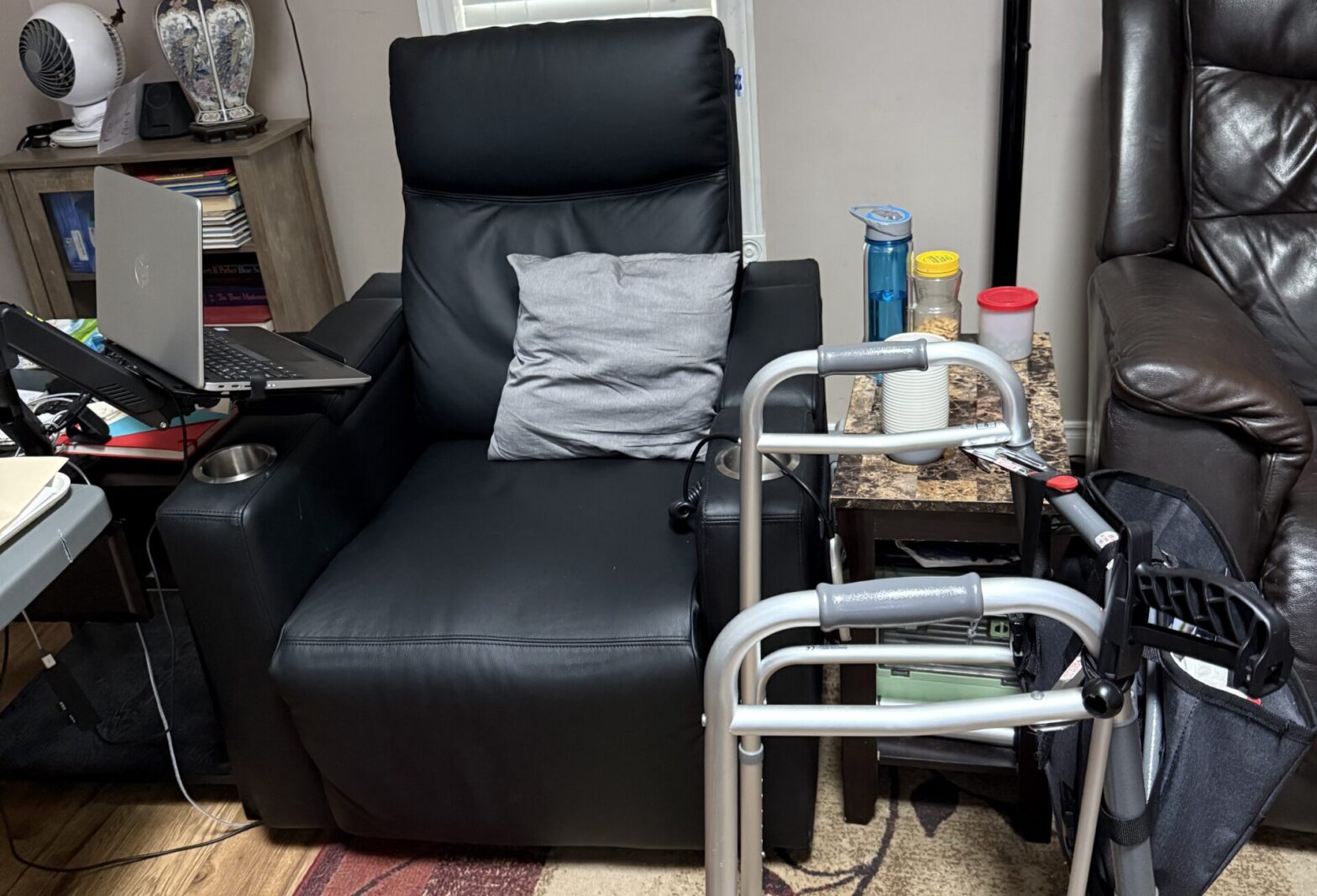
We started wondering whether a powered recliner might be the answer.
We both seemed to remember either the doctor or one of the physiotherapists mentioning that the powered type of recliner could be suitable after hip replacement because it actually helps lift you to standing. You don’t have to lean far forward to get out of the chair and risk breaking your hip precautions.
Glen started hunting for one and found a powered lift recliner on the Costco website.
He ordered it.
I still wanted to be sure we were doing the right thing, but by then I had discovered that my surgeon had gone on vacation. I couldn’t get the answer I needed through his office, so I called the hospital and eventually managed to connect with the physiotherapist.
He said absolutely. The powered recliner would be fine.
I think I got that reassurance only a day or so before the chair arrived at our door.
Which meant yet another disruption for poor Piper.
Our living room was already full, so one of the large reclining couches had to be moved out of its usual spot to make room for my new chair.
By then, the house was starting to look less like our normal living room and more like a recovery zone.
The chairs weren’t the only things that needed to be changed.
Before surgery, I had bought one of those toilet frames that fits over the existing toilet, with a raised seat and arms on either side. It seemed like exactly what I needed.
Once I actually started using it, I decided I didn’t like it at all.
I didn’t like the way the arms connected to the frame, and when you’re already moving slowly and cautiously, you want the equipment you’re relying on to feel solid.
So within days, we were looking for another one.
We found a different model on Amazon, and the replacement arrived on July 22, less than a week after I had come home.
It’s better.
I wouldn’t describe it as comfortable, exactly, but it does the job.
Amazon became rather familiar with our house during those first few weeks.
Some things Glen ordered. Some things I ordered. Between the two of us, I’m not sure I could reconstruct the entire list now.
A lot of it was trial and error.
One of my early ideas was an eight-foot, non-elastic polyester stretching strap with loops, the kind sold for physiotherapy and yoga. It arrived on July 15, and my plan was to hook one of the loops around my foot and use it to guide my operative leg into bed.
I was determined to find some way of doing that myself.
Unfortunately, the leg had other ideas.
Because I had so little control of it, pulling on my foot didn’t necessarily move the whole leg where I wanted it to go. My knee would bend, the leg would get out of alignment, and my hip would start to hurt.
That experiment didn’t last long.
I need someone to guide my leg in and out of bed.
That was one of the harder parts for me.
It wasn’t only that I disliked needing help. I was very aware that every trip to bed, every trip out of bed and every middle-of-the-night bathroom visit also affected somebody else.
Usually Glen.
We did find one small piece of equipment that helps.
A narrow bed rail that slides under the mattress gives me something solid to grab near the top of the bed. I can use it to pull and position the rest of my body while someone else guides my leg onto the mattress.
It also gives me something to hold onto when I start the process of getting back out again.
It is only about a foot wide, but it makes a surprisingly big difference.
Being able to use my computer became another problem to solve.
My regular office setup wasn’t practical. The chair was too low, it was on wheels, and sitting at my desk wasn’t particularly comfortable anyway.
I had a laptop, but using one while sitting in a recliner is easier in theory than in practice. I purchased a laptop arm from Amazon that could clamp onto a table.
The problem was that we didn’t have a table sturdy enough or suitable for the arm. So Glen started checking thrift stores and found a small coffee table.
We clamped the arm onto it and positioned the table beside my new recliner. The computer could swing out over me when I wanted to use it and move out of the way when I was finished. That’s the setup I’m using now.
It was improvised, but it worked.
And being able to sit there and use my computer gave me a small piece of normal life back.
While my surgical dressing was on, we were using extra tape and covering the area carefully for showers, so we went through supplies more quickly than expected and had to order more.
Even cooling the leg wasn’t as straightforward as I expected.
The skin over my thigh had become very sensitive. I had originally thought some of that altered sensation might simply be from all the swelling and surgical trauma, but the femoral nerve also carries sensory signals from parts of the thigh. With the nerve injured, sensation can be altered as well as reduced.
In my case, cold became particularly uncomfortable. I couldn’t tolerate something very cold sitting in one place for the usual length of time, so smaller cold packs worked much better. I could move them around from my knee to my thigh and then to the side of my hip rather than leaving one area exposed to the cold for too long.
Some of the things we bought have worked beautifully.
Some help a little.
Some, like my clever stretching-strap idea, were abandoned almost as quickly as they arrived.
We’re still learning as we go.
Just a couple of days after coming home, on July 17, I went to my first physiotherapy appointment.
Of course, getting there was an event in itself.
Glen had to drive me and help me in and out of the car because I couldn’t manage my operative leg independently. Every trip meant repeating the same careful process we had used when I left the hospital.
Back up carefully.
Sit first.
Then turn while Glen helped guide my operative leg into the car without letting it twist or fall out of alignment.
That first physiotherapy appointment was difficult.
And painful.
I had gone into surgery assuming physiotherapy afterward would be about gradually rebuilding strength and mobility in the usual way after a hip replacement.
That wasn’t quite what was happening anymore.
Because of the femoral nerve palsy, there were exercises I simply couldn’t do.
My physiotherapist explained that, for now, the goal was more about preserving as much strength as possible in the muscles that were still working while we waited for the nerve to reactivate.
That gave my physiotherapy a somewhat different purpose than it might have had after an uncomplicated hip replacement.
I still did the ankle pumps and some of the other exercises I had been taught immediately after surgery.
But there were plenty of exercises that simply weren’t possible yet.
I have continued going to physiotherapy weekly, and the exercises have had to be adapted around what I can actually do.
Sometimes progress means strengthening something.
Sometimes it means preserving what you have while you wait.
By the end of that first week at home, I was beginning to understand just how different this recovery was going to be from the one I had prepared for.
Before surgery, I had tried to think ahead. I had bought equipment, watched the hospital videos, arranged the house and learned the exercises I was supposed to do afterward.
But all of that preparation had been based on one fairly important assumption — that after surgery I would be able to control my leg.
Once that wasn’t true, almost everything had to be reconsidered.
How I got into bed.
What I sat on.
How I showered.
How I got into the car.
What exercises I could do.
Even how I could use my computer.
Some solutions worked. Some didn’t. Some required another Amazon order, a trip through the thrift stores or Glen moving yet another piece of furniture around the house.
What I was learning, and am still living with, is that recovery isn’t just happening to my hip.
It is happening all around us.
Our routines have changed. Our house has changed. Glen and the kids are helping with things I normally would never have needed help with, and even Piper was trying to figure out why her world suddenly looked so different and why I wasn’t letting her in and out of the house.
For now, progress isn’t about getting back to normal.
It’s about finding a way to do the next ordinary thing.
Medical Disclaimer
This post reflects my personal experience with hip replacement surgery and recovery. It is not intended as medical advice, diagnosis or treatment. Everyone’s recovery is different. If you have questions or concerns about your own symptoms, medications or recovery, please speak with your healthcare provider.