By the beginning of Week 5, I was starting to notice a real shift in my recovery.
The femoral nerve palsy was still very much present. My left leg was still weak, my quadriceps were not functioning normally, I still needed my walker, and my knee remained unreliable.
But the hip itself was beginning to feel considerably better.
The pain had decreased quite a bit, although it certainly had not disappeared. I was taking Tylenol Arthritis morning and evening and, until recently, had been adding an Extra Strength Tylenol in the middle of the afternoon. Then one day I skipped that afternoon dose and realized I did not seem any worse for it.
I was also discovering that I felt better when I moved.
If I sat for any length of time, I became stiff and sore. Getting up and moving around regularly seemed to help, and with less hip pain I could do my exercises much more comfortably than I had been able to a couple of weeks earlier.
My knee, however, continued to be a concern.
It felt stiff and swollen, and bending it was difficult. One of my standing exercises involved holding onto my walker, standing upright and bending my knee to bring my foot up behind me. I could bend it partway, but nowhere near as far as I normally could.
My physiotherapist explained that working on the bend was important because we did not want the knee becoming increasingly stiff while I was dealing with the palsy.
He also added another standing exercise that looked a little like marching. While holding onto the walker, I lifted my left knee forward and upward.
And I could do it.
Not very high, but I could do it.
That requires a little explanation because throughout this recovery I have often said that I could not lift my leg.
What I really meant was that I could not perform a straight-leg raise.
If I lie down with my left leg straight and try to lift the entire leg off the bed, it does not move.
At all.
It does not lift a little bit. It does not start to come up and then stop. It simply stays where it is.
The standing marching movement is different. I can flex at the hip enough to bring my knee forward a short distance, even though I still cannot lift the entire leg from the bed while keeping my knee straight.
So being able to make a small marching movement does not mean that particular problem has resolved.
My straight leg still does not budge.
I am also still following my hip precautions and am not supposed to flex the hip beyond 90 degrees. I am not testing that limit, and at this point weakness and discomfort already restrict how high I can lift the knee.
My physiotherapist wants me doing my exercises frequently, ideally every two to three hours. Along with the standing knee bends and marching, I continue with ankle pumps and gluteal squeezes. For the standing exercises, I generally do 10 repetitions, holding each for a count of 10, and work toward 20 when I can manage it.
I do not always get them done as frequently as recommended, but the reduction in hip pain is making exercising considerably easier.
There has been another sign of progress at physiotherapy.
About a week ago, my physiotherapist had me practise standing from the treatment bed using only his fingers for support. That allowed him to tell how much help I was actually using to get myself upright.
This past Friday, he positioned the treatment bed at the appropriate height with my walker in front of me, and I was able to stand without pushing myself up with my hands or using him for assistance.
Then I sat down and did it again.
And again.
I think I did about 20 sit-to-stands.
Before surgery, standing from a chair without using my hands was something I could easily do. Being able to start doing it again felt like another small step toward getting some of that function back.
I can actually stand and maintain my balance without holding onto anything, although I prefer to have something stable nearby. What I cannot safely do is take steps without support. My left knee remains too unreliable, and I cannot trust it not to buckle.
The nerve palsy has also left me with some very strange sensations in the leg.
The best way I can describe it is to compare it with dental freezing.
If you have ever had local anaesthetic at the dentist and then touched your cheek while your mouth was still frozen, you know the feeling. You can tell that you are touching your face, but it does not quite feel like your face.
That is how much of my leg feels.
The altered sensation extends down the leg. From around my knee toward my ankle, it still feels quite frozen much of the time. Parts of my thigh feel somewhat different than they did earlier, almost as though some of the dental freezing is beginning to wear off.
At the same time, the skin can be extremely sensitive. Pressure or touch that ordinarily would not bother me can be surprisingly uncomfortable.
I do not know what those changing sensations mean in terms of nerve recovery. They are simply what my leg feels like right now.
As Week 5 moved into Week 6, I was becoming increasingly determined to do more for myself.
I have been told that recovery from the femoral nerve palsy could take months and possibly much longer. I was beginning to accept that I might be dealing with a poorly functioning leg for quite some time.
And it is not just the leg.
It is everything that comes with it.
The walker. The reacher. The leg-lifter strap. The shower chair. The raised toilet seat. The hip precautions. The unreliable knee. And the constant need to think about how I am going to accomplish things that I once did without giving them a second thought.
I cannot simply put my life on hold while I wait for the nerve to recover.
I need to learn how to work with the situation I have right now.
I am adapting.
My physiotherapist still feels that the standard walker is the best mobility aid for me at this point. Fortunately, mine is relatively lightweight and folds quite compactly.
Early in my recovery, I bought a pouch that straps onto the front of it. It has turned out to be incredibly useful because I need both hands available for the walker. The pouch gives me a way to carry things without trying to hold them while I walk.
I also attached a reacher to the walker so I almost always have one with me.
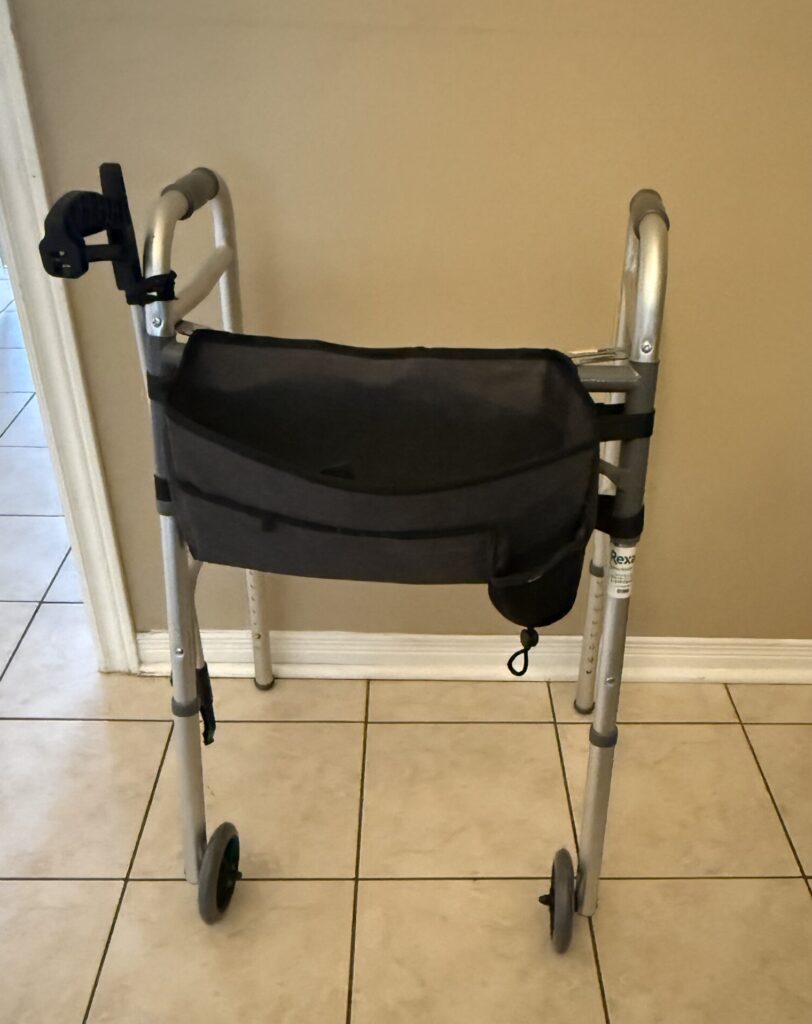
Going somewhere requires its own little routine. Before the walker goes into the car, I take off the pouch so nothing falls out and remove the reacher so the walker folds easily.
Even my adaptive equipment has accessories that need managing.
One of my Week 5 milestones involved getting into and out of the car.
I had reached the point where I could manoeuvre my operated leg into and out of the passenger side without someone physically lifting or guiding it for me, but there is considerably more to the process than simply opening the door and getting in.
Before I get into the car, the passenger seat is slid as far back as it will go and the seatback is reclined. I sit on the edge of the seat and lean back, which gives me enough room to work myself and my leg farther into the car without breaking my 90-degree hip precaution.
Once I am safely in, I can reach the seat controls and bring the seat into a more normal position.
Getting out involves reversing the process.
I still need someone to get my walker out of the car and position it in front of me before I stand. I also cannot safely reach out far enough to pull the car door closed without risking breaking my hip precautions, so I need help with that too.
Still, no longer needing someone to physically manoeuvre my leg into and out of the car feels like real progress.
I have started thinking about driving again as well.
Because this is my left leg, I can imagine eventually folding my lightweight walker and putting it on the passenger seat beside me. But I am not there yet.
I am waiting for clearance from my surgeon and for my hip precautions to be lifted. Getting into the driver’s side will also present different challenges from the passenger-side transfers I have been practising.
That is something for another day.
Around the house, I have started looking for other things I can safely manage.
Then our dishwasher decided to help with the experiment by breaking down.
It was only about six months old. Glen tried the recommended troubleshooting, but all it would do was flash lights at us. The manufacturer eventually confirmed that it needed a technician.
In the meantime, there were still dishes.
I discovered that I could empty the upper racks myself and stand at the kitchen sink to wash the dishes. I could not safely manage the bottom rack, so when my daughter-in-law was over, she emptied that part for me and I washed those dishes too.
I also washed my hair by myself at the kitchen sink one day while no one else was home.
Laundry became another exercise in problem-solving.
Fortunately, our laundry room is on the main floor, and our front-loading washer and dryer are raised on pedestals.
Glen had put a load of washing in before he left for work, so I did not have to manage the whole job. My task was to get the wet clothes from the washer into the dryer and then, once they were dry, figure out how to get them out and where they needed to go.
I could use my reacher to retrieve clothes from the back of the machines without bending beyond my hip precautions.
Getting the laundry out of the machines turned out to be easier than figuring out what to do with it afterward.
There was no way I could safely manage a heavy, full laundry basket.
At first, I used the pouch on the front of my walker to carry some of the clean clothes toward the bedroom. Once the basket was lightly loaded, I manoeuvred it onto an area of hard flooring. From there, I could put it in front of my walker and gently push it along toward the bedroom.
It was not exactly an efficient laundry-delivery system, but it worked.
Not every experiment was successful.
I tried vacuuming a small area. I leaned against something for additional support and attempted to do just a little bit, but I did not feel comfortable or secure enough.
So I stopped.
That is part of adapting too.
The goal is not to prove that I can do something. If I cannot do it while respecting my hip precautions, protecting myself from a knee that can still buckle and remaining safely supported, then it can wait.
Another simple piece of equipment has made a surprising difference.
I bought a new leg-lifter strap that is stiffer than the one I had been using. Because it holds its shape, it is easier to get the loop around my foot.
When I get into bed, I use the strap to help guide my left leg onto the mattress. I leave the loop around my foot so that if I need to get up during the night, I can reach for the strap and use it to lower the leg to the floor.
At least, that is the plan.
The last few nights, the strap has occasionally managed to come off while I was sleeping.
That has led to some interesting middle-of-the-night manoeuvring.
I have learned to use the strap and my other foot to work the loop back around my left foot while I am lying in bed. Sometimes I even use the toes of my right foot to grasp the loop and help guide it into position.
All of this takes place in the dark while I am trying not to wake Glen.
That effort is probably a little ridiculous considering that, once I get upright, I start clunking around the bedroom with my walker anyway.
But there is an important difference.
Even if I wake Glen, he no longer has to get out of bed.
Earlier in my recovery, every nighttime trip to the bathroom meant Glen had to get up too because I needed his help manoeuvring my leg into and out of bed. Now, between the strap and the techniques I have figured out for using it, I can manage the transfer myself.
That is progress for both of us.
I do not think the strap deserves all the credit, though.
Two weeks earlier, when my hip was considerably more painful, I am not sure I could have managed the same manoeuvres even with the better strap. As the surgical pain has decreased, things that were previously too painful have become possible.
Sleeping itself remains more complicated.
I still cannot lie on my operative side because it hurts. I have tried lying on my non-operative side once with a pillow between my legs, but that did not work well either. I plan to try it again as I become more comfortable.
There was another major change during these weeks that was easy to overlook.
During Week 5, I gradually began spending more time at home on my own. I think there was only one day that week when someone stayed with me while Glen was at work.
By Week 6, I was managing the days by myself. If I needed help, I could call one of our children who lives nearby, but I no longer needed somebody physically present with me throughout the day.
That felt significant.
Near the end of Week 6 came another milestone.
I was able to manage my shower independently.
Glen was still in the house and stayed nearby in case I needed him, but I got into the shower, showered without using the shower chair and got back out on my own.
I am still very cautious about falling, especially getting into and out of the shower, but I am becoming more confident.
One of the things I have learned is that everything has to be set up before I start.
I need my towels where I can reach them, the floor mats properly positioned so I do not step onto a slippery floor, and my walker placed where I can use it for extra support as I get into and out of the shower.
The shower chair is still there if I need it, but on my most recent shower I did not use it.
It is another example of how much of my independence now depends on planning ahead. I can do more for myself, but I have to make sure the environment is set up so I can do it safely.
Even showering has required some creative problem-solving.
I use a bar of soap for sensitive skin, and I have an unfortunate tendency to drop it.
Under normal circumstances, dropping the soap would be a minor nuisance. Right now, if it lands on the shower floor, I cannot safely bend down and retrieve it myself.
So I have a plan.
Someone is picking up a pair of pantyhose for me from the dollar store. I am going to put the bar of soap into the foot of one leg and use the other leg to secure it somewhere within reach in the shower.
If I drop the soap, I should be able to pull it right back up.
Consider it my homemade version of soap on a rope.
Recovery certainly encourages creativity.
Of course, ordinary life also has a way of creating problems completely unrelated to hip replacements.
At my granddaughter’s birthday celebration, there were some gumdrop-type candies among the treats.
I ate one.
I think I knew better.
The candy promptly pulled the crown right off one of my molars.
By Tuesday, I was sitting in the dentist’s office.
Since I still could not drive, I had to arrange a ride, and my daughter-in-law kindly took me and came inside with me. She helped me get my leg positioned in the dental chair. When the procedure was finished, they called her back in so she could help me get the leg down again.
I had remembered reading in my preoperative information that I should tell my dentist about my recent hip replacement if I needed dental work. I mentioned it to him, and he decided to prescribe an antibiotic.
Even losing a crown had become more complicated.
There was another member of the household who seemed to be adapting to all of this too.
Piper had been unsettled by the changes after my surgery — the walker, changes in the house, my different movements and the fact that I could not interact with her the way I normally did.
One afternoon near the end of Week 6, it was just Piper and me at home. She had been to doggy daycare the day before, so she had been relatively quiet for most of the day.
Then 5 o’clock arrived.
Piper came back to life.
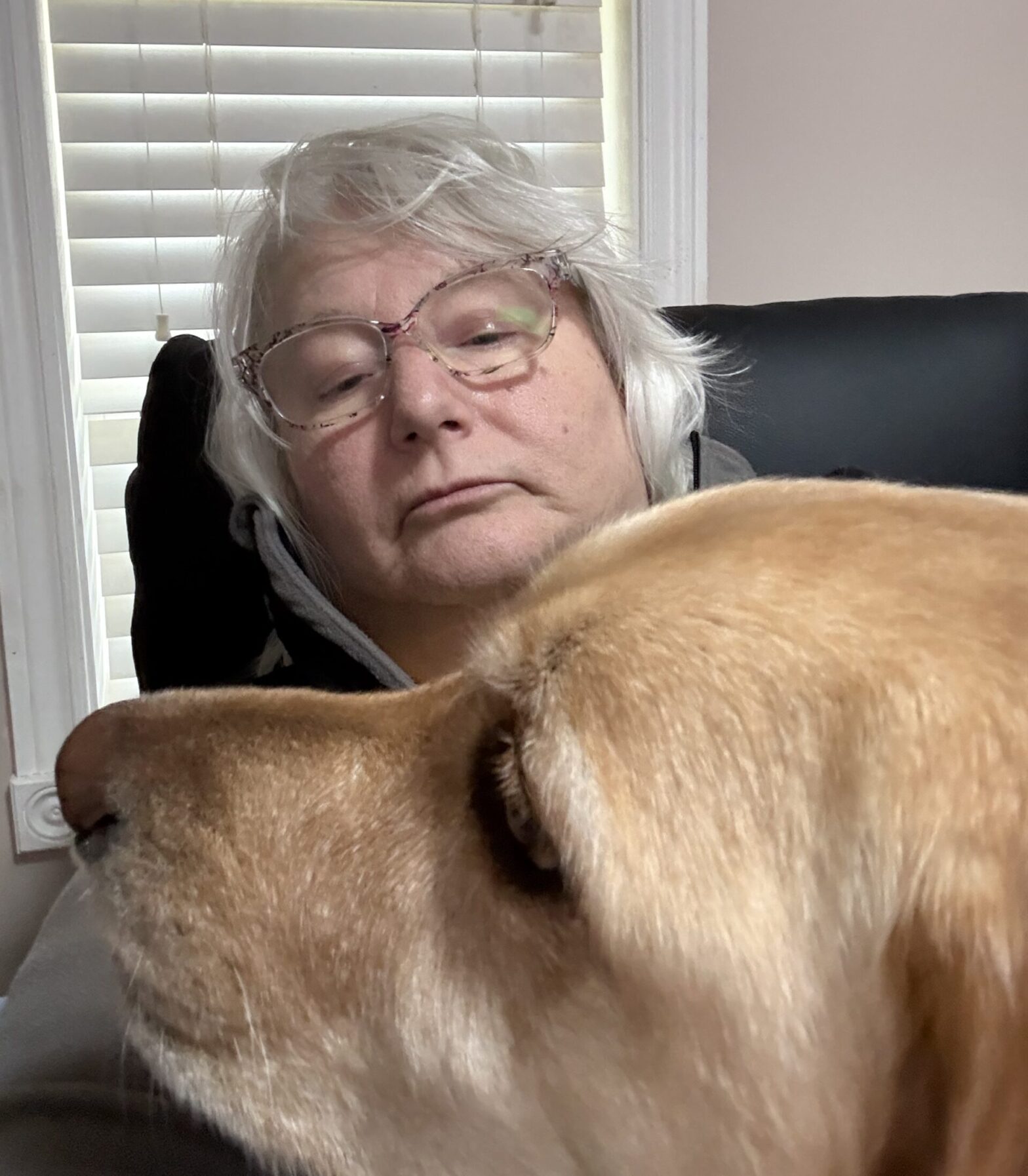
I gave her a couple of peanuts, and before long she had a paw up on my chair. The next thing I knew, about three-quarters of an 84-pound Labrador was on top of me and she was right up in my face looking for attention.
One of her very substantial paws was planted on my operative leg.
It did not cause pain in the hip joint itself, but the altered sensation and hypersensitivity in that leg meant the pressure from her paw was far more uncomfortable than it normally would have been.
I sat the recliner up, repositioned her enough to get the pressure off that area and then enjoyed the cuddle.
And somehow I even managed to take a picture.
It seemed Piper was adapting too.
Then Friday morning brought a milestone of an entirely different kind.
An email arrived from the Canadian Intellectual Property Office.
After a long process, the Peacock Pen Press trademark was officially registered.
I had spent so much of the summer thinking about my hip, my leg, exercises, medications, walkers and nerve recovery that receiving genuinely exciting news about something completely unrelated to my health felt wonderful.
I wrote separately about the journey to getting the trademark registered because that turned out to be quite a story of its own.
As Week 6 comes to an end, I can see how much has changed.
My hip pain is considerably better. I can do my exercises more comfortably. I can stand up from an appropriately raised surface without pushing myself up with my hands. I can manoeuvre my own leg into and out of the car. I am finding ways to do dishes, laundry and other small jobs around the house. I am managing more of my personal care independently, and I no longer need someone staying with me during the day.
The femoral nerve palsy, however, has not disappeared.
My left leg still will not budge when I try to perform a straight-leg raise. My knee remains stiff and can still buckle. I can stand unsupported, but I cannot safely take steps without something to hold onto. I still need my walker and the collection of adaptive devices that has gradually become part of everyday life.
There are things I cannot safely do, and I am learning not to push past those boundaries simply because I want my old independence back.
My original 30-day prescription for blood thinners also came to an end during this period. Because my mobility has been considerably more restricted than it would be after an uncomplicated hip replacement, I wondered whether the usual duration still made sense for me. I was able to obtain enough medication to continue until I could discuss the question with my doctor rather than making that decision myself.
Perhaps the biggest change during Weeks 5 and 6 has not been a particular exercise or household task.
I am learning how to live with the nerve palsy — and with everything that comes with it.
I do not know how long it will be part of my life. Recovery could take months, and possibly much longer. That makes becoming as independent as I safely can increasingly important to me.
I am not willing to put my life on hold while I wait.
I am adapting.
Next week, during Week 7, I see my surgeon again.
I am looking forward to that visit. I have made real progress, especially with the hip itself, but I still have plenty of questions about the femoral nerve palsy, my quadriceps weakness, the stiffness in my knee and what I should expect from the next stage of recovery.
I am also looking forward to finding out when some of the remaining hip precautions can be lifted and, eventually, when I can safely think about driving again.
For now, though, I can look back at these two weeks and see progress in places I might once have overlooked.
Sometimes progress is being able to manoeuvre your own leg into and out of the car.
Sometimes it is knowing when to put the vacuum cleaner back down.
Sometimes it is getting yourself out of bed in the middle of the night without making your husband get up too.
And sometimes it is simply being able to enjoy having three-quarters of an 84-pound Labrador in your lap again.
I am still recovering.
But I am also getting back to living.