When I filed an application to trademark Peacock Pen Press on December 27, 2024, I knew it wasn’t going to happen overnight.
I don’t think I appreciated quite how long the journey would be.
Nor did I appreciate how particular the Canadian Intellectual Property Office could be about the difference between knowing perfectly well what you mean and describing it in exactly the way they want you to mean it.
Peacock Pen Press had grown from an idea into something I was serious about building. I had the name, the website, plans for books and other publishing projects, and more ideas than I was ever likely to have time to pursue. At some point, protecting the name seemed like the sensible next step.
So I decided to apply for the trademark myself.
I did not use a trademark agent or lawyer. I researched the process, went through the Canadian Intellectual Property Office — CIPO — and filed the application.
Then I waited.
As it turned out, I didn’t have to wait very long for my first lesson.
On January 9, 2025, less than two weeks after I filed, CIPO sent me a pre-assessment letter.
Their automated analysis had looked at the goods and services in my application. Some of my terminology wasn’t on CIPO’s pre-approved list of goods and services, although the letter did indicate that at least some of what I had submitted was acceptable.
This wasn’t a rejection, and there was no deadline to respond to the letter. It was essentially an opportunity to clean things up before the application reached formal examination.
That was my introduction to something I would come to understand much better over the following year: when you apply for a trademark, it isn’t enough for your description to make sense in everyday language.
You need to describe your goods and services using terminology and a level of specificity that satisfy trademark requirements.
There is a difference.
I worked on the wording and submitted additional information.
And then I waited again.
Nothing about this process happens quickly.
My application had been filed in December 2024. It wasn’t until December 5, 2025 — almost a year later — that a search was recorded and CIPO issued the examiner’s first report.
This time it was more than a helpful pre-assessment.
The examiner had concerns about the way some of my goods and services were described. Canadian trademark applications require goods and services to be stated in “ordinary commercial terms” and with enough specificity to identify what they actually are.
The basic nature of Peacock Pen Press hadn’t changed. I was still publishing books and other content. The problem was largely how some of those activities had been expressed in the application.
And this time there was a deadline.
CIPO needed a proper response by June 5, 2026, or the application could face abandonment proceedings.
Those are not comforting words to find in a government letter.
By then I had money invested too.
Applying for a trademark isn’t cheap.
By the time I received the examiner’s report, I had already paid the government filing fees and invested a considerable amount of time in the application. Simply abandoning it and starting over wasn’t an appealing option.
That made the June deadline feel more significant. I wanted to get the wording right, but I also didn’t want to panic and immediately spend more money on professional help if the problem was something I could reasonably correct myself.
I had already come too far to casually let the application lapse.
Something else happened after the examiner’s report appeared.
I started receiving offers of help.
I received a couple of letters in the mail from legal offices offering trademark services. I eventually tossed those, so I can’t tell you exactly when they arrived or what each one said.
But I kept an email.
On January 20, 2026, a Canadian trademark lawyer and agent emailed me. He knew the name Peacock Pen Press, knew my application number and knew that CIPO had issued an examiner’s report. He offered to help me deal with it for an undisclosed flat fee.
Interestingly, when CIPO finally approved my application on March 9, the approval notice contained a warning I could have used a couple of months earlier. It cautioned applicants about invoices concerning their applications that came from anyone other than CIPO and warned that private-sector companies sometimes solicit trademark applicants for fees.
By then, I already understood just how public the trademark process was.
There was nothing mysterious about how these people had found me. Trademark applications and their progress are publicly searchable.
Still, there is something slightly unnerving about receiving a government examiner’s report and then having lawyers you have never contacted begin offering to help you with it.
It does make you wonder whether you have wandered into waters deeper than you realized.
I considered my options.
I could hire a trademark professional, and there are certainly circumstances in which I would have done exactly that.
But when I looked carefully at what the examiner was asking for, the problem didn’t seem to be that Peacock Pen Press itself couldn’t be trademarked. The examiner wanted changes to the way I had identified and described the goods and services.
That seemed like something I could at least try to resolve myself.
I also had something I hadn’t had for most of my working life: an AI assistant sitting on my computer.
I used ChatGPT to help me work through the examiner’s report, understand the terminology and refine the wording of my response. I also used CIPO’s own information to check what was required.
ChatGPT wasn’t my lawyer, and I didn’t treat it as one. Ultimately, this was my application and my responsibility.
There was also a deliberate bit of risk management involved.
I didn’t wait until May to see whether I could figure it out.
The deadline wasn’t until June 5. By responding well ahead of it, I knew that if my attempt didn’t work — or if CIPO came back with something I couldn’t confidently resolve — I would still have time to contact a trademark lawyer and get professional help.
Plan A was to see whether I could handle it myself.
Plan B was sitting there if I needed it.
I didn’t need Plan B.
On March 9, 2026, the status of my application changed.
Approved.
Seeing that single word felt like a significant victory.
The final application described Peacock Pen Press under Class 16 for goods including books, children’s books, children’s storybooks, children’s activity books, picture books, fiction books, educational books, drawing books, colouring books, notebooks, workbooks, exercise books, printed manuals, printed booklets, printed brochures and cartoon prints.
Class 41 covered publishing and distribution of books, e-books, audiobooks and digital content, along with online publishing services and educational publishing.
In other words, it described what I had been trying to say all along.
It just said it in CIPO language.
Of course, I soon learned there was another distinction to make.
Approved did not mean Registered.
After approval, the trademark still had to be advertised so that others had an opportunity to oppose its registration.
Peacock Pen Press was advertised in the Trademarks Journal on June 3, 2026.
And so began another wait.
The normal opposition period is two months. I watched the calendar creep toward August 3.
August 3 came.
August 3 went.
No opposition appeared.
Wonderful.
Except that when I checked the CIPO database, the status still said:
LIVE/APPLICATION/Published for Opposition.
Even the end of the waiting period required some waiting.
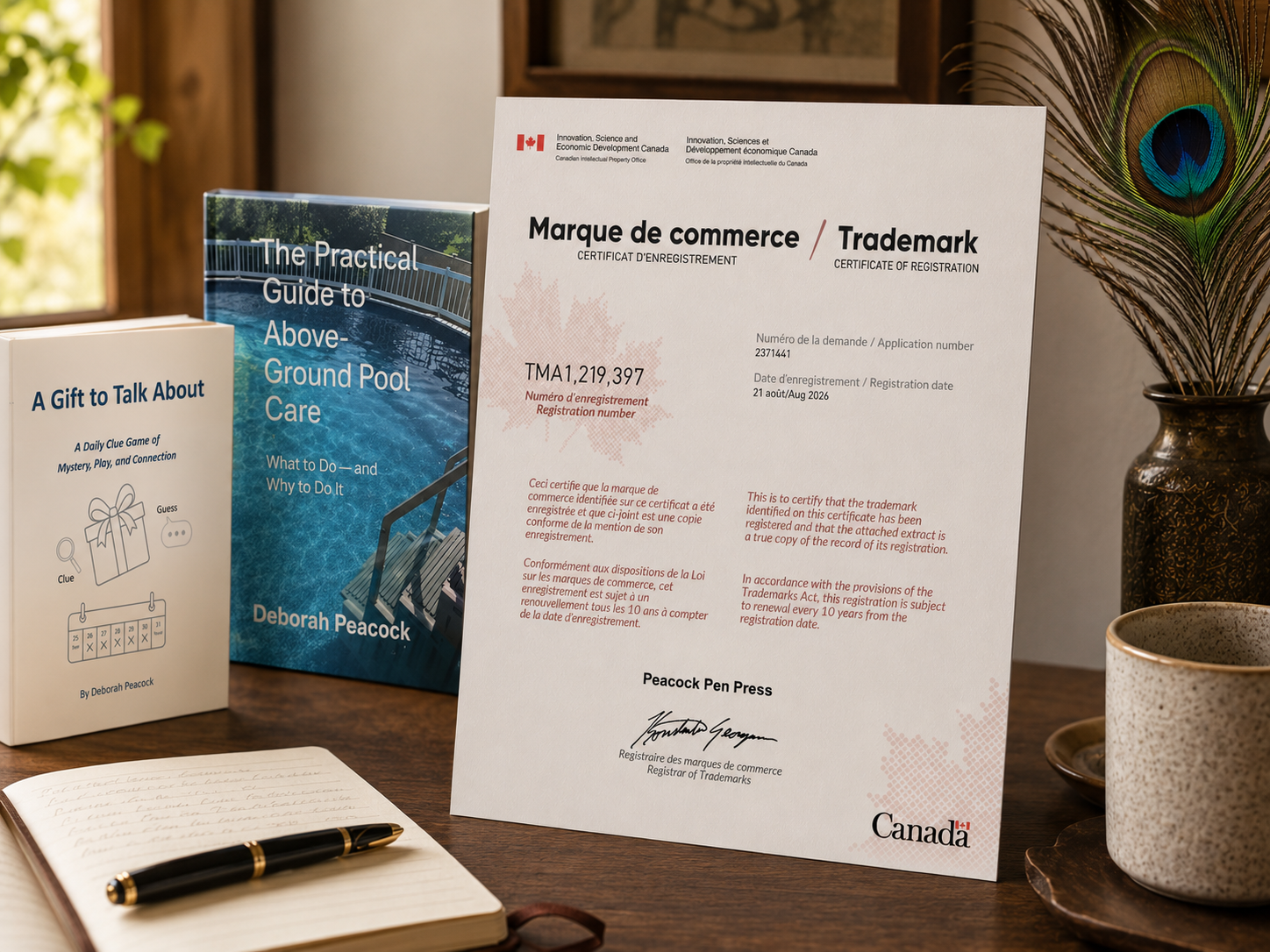
Then, on August 21, 2026, the email arrived.
Attached was the Certificate of Registration for Peacock Pen Press.
After automated assessments, revised terminology, a formal examiner’s report, publication for opposition and an impressive amount of waiting, it was official.
Peacock Pen Press was a registered Canadian trademark.
There was one other small episode in this adventure that seems too good not to mention.
In April, after my application had been approved, I received an invitation to participate in a CIPO client satisfaction survey.
CIPO had retained an independent research company to find out what clients thought about its services and their experiences with the office.
After spending more than a year trying to describe books and publishing in precisely the right way for CIPO, CIPO now wanted to know how I felt about them.
There was something wonderfully Canadian about the whole thing.
The survey was estimated to take about 20 minutes.
Of course it was.
Would I handle my own trademark application again?
I think I would, under the right circumstances.
My application was relatively straightforward. I was trademarking a name I was already using for my own publishing business. When the examiner raised concerns, they involved the description and classification of my goods and services rather than a dispute with another trademark owner.
I also gave myself room to change course.
That’s probably the most important lesson I took from this part of the experience.
Trying to handle something yourself doesn’t have to mean refusing professional help. Sometimes it means understanding what you can reasonably attempt, knowing when you’re getting beyond your expertise and leaving yourself enough time to call someone who knows more than you do.
ChatGPT was useful to me as a research and thinking tool, particularly when I was trying to understand exactly what CIPO wanted changed. But if the revised application hadn’t been accepted, I wouldn’t have kept arguing with an AI until my deadline expired.
I would have called a trademark professional.
Fortunately, I didn’t have to.
I filed the Peacock Pen Press trademark application on December 27, 2024.
Since then, there have been automated assessments, revised terminology, a formal examiner’s report, unsolicited offers from lawyers, an approval, publication for opposition, a satisfaction survey and an impressive amount of waiting.
And somewhere along the way, something else happened.
While CIPO was deciding whether Peacock Pen Press could officially become my registered trademark, I was busy making Peacock Pen Press real.
I worked on the website. I wrote. I published. I learned. I made mistakes. I changed plans. I started new projects. I abandoned a few. I came up with more ideas.
The government spent the better part of two years processing the name.
I spent those same two years building what the name stands for.
And now, at last, the database has the word I was waiting for:
Registered.
I can’t pretend I’m not pleased with myself.