September 7 marks exactly eight weeks since my left hip replacement.
This is not the recovery I expected to be writing about.
Despite everything that has happened, I am very happy that I had the hip replacement. Every step is still difficult and may bring a different sort of pain, but the constant pain I used to feel in the hip with every step is gone.
I have also discovered that I can lie on my side for periods during the night. I had not been able to do that for the last couple of years because of the arthritis in my hip. I may not stay there all night, but simply being able to sleep in that position again feels like getting back something the arthritis had taken away.
The femoral nerve palsy continues to affect my entire leg, from my thigh through my calf and down to my ankle. The weakness is not simply a matter of one poorly functioning quadriceps muscle. My thigh and calf are affected, much of the leg remains numb or strangely sensitive, and my knee is still too unreliable for me to walk safely without my walker.
Even so, Weeks 7 and 8 have brought some important answers and several very welcome pieces of ordinary life back.
I saw my surgeon on August 27.
He explained that my surgery had been extremely difficult, among the top five percent of the most difficult cases he has encountered during his career.
I have very strong muscle tone, and he said my muscles did not fully relax even with the spinal anaesthetic. It sounded as though my own anatomy fought him every step of the way. But the new joint still had to be put together. He had no choice but to manoeuvre my leg through some unusual and extreme positions until he could get the ball seated securely in the socket.
I am very glad he did.
When he described what had been necessary, I told him, “Legs aren’t supposed to go like that.”
As he spoke, I pictured the way you sometimes have to bend and twist a doll’s leg to get it back into its socket.
Although no one can say with certainty exactly when the injury occurred, the surgeon believes the difficult manoeuvring and extreme positioning required to complete the hip replacement may have stretched the femoral nerve. He explained that, with the lateral approach he uses, the femoral nerve is not normally within the operative field and is less exposed to the risks of being caught by a retractor or cut. In my case, he believes a stretch injury is the more likely explanation.
That was encouraging to hear because he said stretch injuries generally heal faster than nerves damaged in other ways.
My operated leg was also lengthened during the surgery. I remember the surgeon saying eight millimetres, while Glen remembers nine, which is why I am using an estimate of eight or nine millimetres. Surgeons do not simply lengthen a leg without reason. The severe arthritis and degeneration in my hip had left that leg shorter, and the length was restored during the replacement to make my two legs as even as possible. I do not know whether that necessary correction contributed to the nerve being stretched, but it is another detail that may be relevant.
My surgeon is a very experienced orthopaedic surgeon with extensive experience in joint replacement. He told me that femoral nerve palsy has been a very rare complication in his practice.
It seems I have once again managed to be unusual.
Glen, with a wry grin, told the surgeon, “I’ve always told her she’s special.”
The surgeon ordered a specialized ultrasound to examine the femoral nerve in my groin. One of the questions is whether the nerve has become tethered or caught on surrounding tissue. If that has happened, he said it might be possible for a plastic surgeon to release it.
I had the ultrasound on September 4. The 19 images have now appeared on the online platform where I can view my medical imaging, but the radiologist’s report has not yet been posted.
Getting to the ultrasound department became an adventure of its own.
Glen dropped me at the hospital’s front entrance, where I found a transport chair. I folded my walker, placed it in the chair and began pushing the chair toward the ultrasound department. I was hoping Glen would catch up with me and I could then sit in the chair for the rest of the trip.
I made it partway before my leg became extremely fatigued. I asked a hospital employee for directions, and he started guiding me through the hall. I then asked whether he could push me in the chair instead.
He did, and I was very relieved. Glen caught up with me while I was waiting in line to register.
That experience was a good reminder that being able to do more does not mean I can do it for very long. My leg still tires quickly and sometimes quite suddenly. The trip to the department tested my endurance, while the ultrasound itself left me waiting for answers: I know the test has been completed, but I do not yet know what it showed.
I have looked at the images, but I am not going to try to interpret them myself. I will wait for the written report.
I also have an EMG of the left leg booked for November 4. That should provide more information about how the nerve and affected muscles are functioning.
At this point, it is reassuring to have a possible explanation for what happened. The ultrasound report may tell us a little more, and the EMG may add another piece to the picture. But the exact mechanism is not the most important issue to me. Femoral nerve palsy is a known postoperative complication of hip replacement, although it is fairly rare. It happened to me, there are now some early signs that it may be healing, and nothing I have learned suggests that it resulted from something unnecessary or something that should not have been done.
While I wait for those answers, I have been watching closely for signs of change in my leg, and there have been some differences in the way it feels.
While I was still in the hospital, I remember having an itch on the back of my thigh just above my knee. I asked Glen to scratch the area for me, but I could not feel the scratching at all.
I can feel touch and scratching there now. The sensation is still altered and the area still feels numb, but it is different from the complete lack of feeling I experienced earlier.
Peripheral nerves are often said to regenerate at roughly one millimetre per day once axonal regrowth is underway. Using that rule of thumb, eight weeks would work out to approximately 56 millimetres, or 5.6 centimetres. That is only a general estimate, not proof that my nerve has healed that exact distance. Still, it may help explain why the first noticeable sensory changes are appearing in the upper part of my thigh, closer to the site of the injury.
There has also been a tiny but definite change in movement. When my leg is hanging freely and is not resting against anything, I can now swing it a little.
It is not a large movement, but it is something I could not do before. I could hardly wait to show my physiotherapist.
My left foot, calf and thigh are still more swollen than the right side. The swelling increases when I spend a long time on my feet, and my calf can become uncomfortable when the swelling is pronounced. At my August 27 appointment, the physician assistant examined my calf and did not find clinical signs suggesting a blood clot. The swelling was also discussed with my surgeon.
I am still wearing shoes about a size and a half larger than my normal size much of the time. I tried one of my usual pairs of slip-in shoes and discovered that I did not have enough force or control in the left leg to push my foot into it easily. Once I finally got the shoe on, it also felt tighter because of the swelling.
My regular shoes are not quite ready to make a full return.
Despite the continuing weakness and swelling, my ability to do things around the house has continued to increase.
One household change happened as soon as I came home from the hospital with a walker. The temporary gate with a door that we sometimes used to keep Piper out of the kitchen had to be removed so I could move through freely. The other gates that kept her out of the office area soon came down too. This was a big win for Piper and required a little more diligence from the rest of us. She is always looking for food, and if we are not careful, she will find a way to get at some. So far, the new arrangement has been largely successful.
On September 1, I vacuumed five carpets by moving my Dyson in separate pieces. I also did two loads of laundry by pushing the basket along rather than carrying it, and I spent considerable time working in the kitchen.
I accomplished a lot, but my leg made sure I knew I had done it. By the end, I was extremely tired and considerably more swollen.
Progress does not mean that my body has stopped setting limits. Sometimes it means discovering exactly where those limits are.
That same mixture of progress and limitation is evident in my walking. At physiotherapy this past Friday, my physiotherapist commented that I was walking much better. I can move faster with the walker now, but there is an important qualification: I have to keep my left leg straight. If I bend the knee at all while putting weight through it, the leg will not support me.
So my walking looks better and feels more efficient, but the underlying weakness is still very real.
I am also still very hesitant about uneven surfaces. My standard walker has wheels on the front and can feel a little tippy when the ground is not level. An uneven surface could make it even harder to keep my knee straight and stable, so I am not yet confident about trying unfamiliar places.
I was given a Zimmer knee brace when I left the hospital. I can now manage without it around the house, but if I were going to walk on an uneven surface, I think wearing it for the added support would be a good idea.
Although walking still requires support and caution, I have been able to retire some of the equipment I needed earlier in my recovery. On September 3, I decided to try getting into and out of bed without using the leg-lifter strap.
I did it twice, and both attempts went well.
I think being able to retire the strap has a great deal to do with the decrease in my hip pain. The tiny amount of returning movement may be helping too. Whatever the balance between those two things, I can now move the leg into and out of bed without using the strap, and that is a meaningful improvement.
That gave me enough confidence to remove the raised toilet chair that had been sitting over our toilet. I used the regular toilet and managed to stand up without using the arms of the raised chair to assist me.
More than simply getting rid of another piece of equipment at home, that gave me a sense of freedom. If I were at a restaurant or somewhere else and needed to use the bathroom, I could be confident that I would not be left stuck on a toilet because there were no raised seat or arms to help me stand.
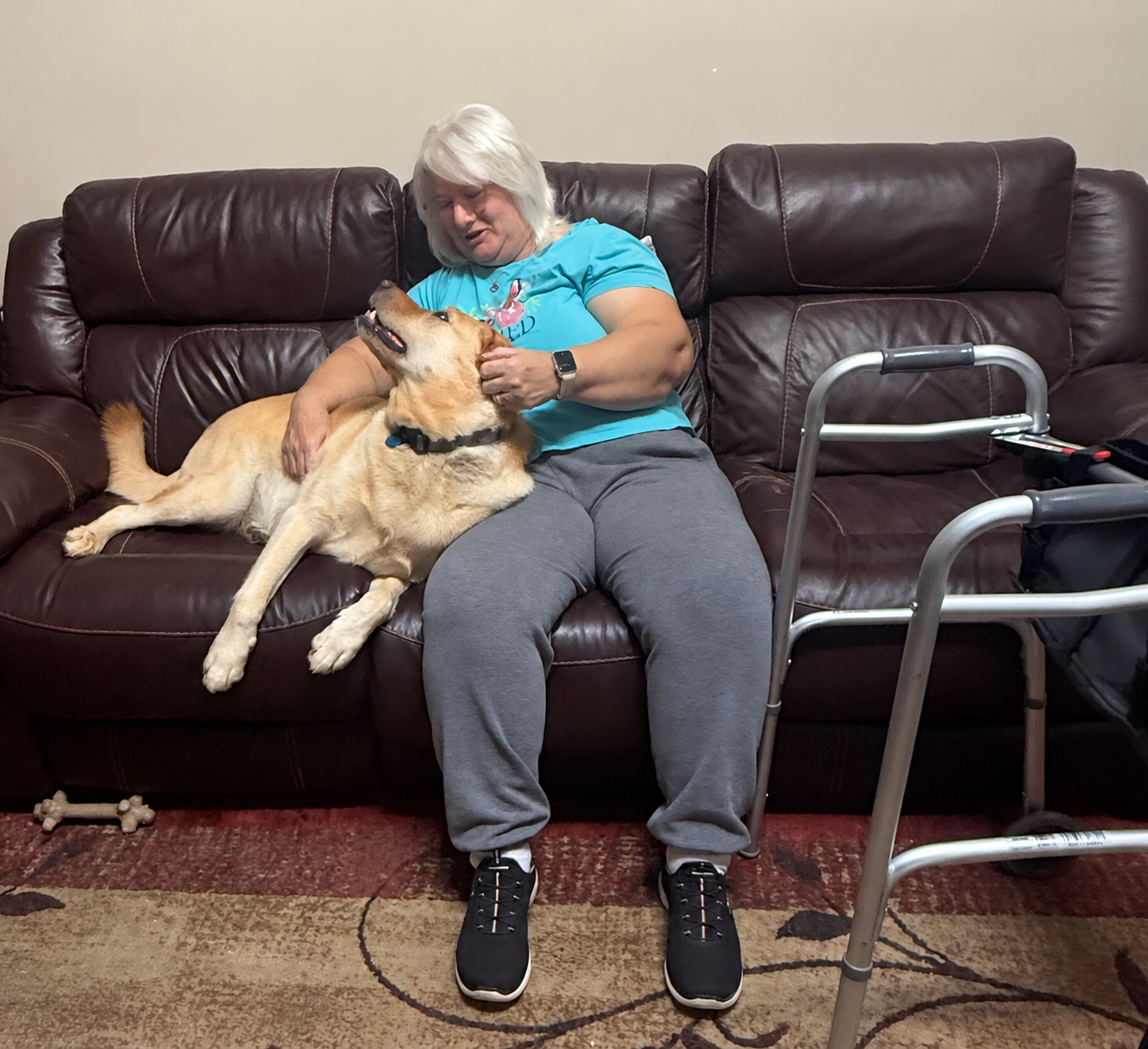
Then I sat down beside Piper on the couch. I would naturally call it the Chesterfield, but I am told that may be showing my age.
I chose the middle cushion because it is the highest part of our couch. Piper and I had a lovely cuddle, and when it was time to get up, I managed that too.
Those may sound like small things. After weeks of needing a strap to move my leg, extra height to stand up, and careful planning before sitting almost anywhere, they did not feel small to me.
During Weeks 5 and 6, I had started thinking about how I might eventually manage the driver’s side and where I could put the walker. At that point, driving was still something for another day.
By the end of Week 8, that day had arrived, bringing one of my biggest milestones yet. It was also a carefully planned one.
I made my way out to the garage and got into the driver’s side of my car. I managed to bring my left leg into the car myself without using the leg-lifter strap. I folded my lightweight walker and fitted it beside me. Then I drove to physiotherapy.
It was the first time I had driven since before my surgery eight weeks earlier.
Because it is my left leg that is affected, it is not the leg I use to operate the accelerator or brake. Glen came with me to make sure I could get out of the car safely at the other end. I did. He then made sure I got safely into the physiotherapy clinic before taking the car to run errands while I was there.
I am still better off keeping my drives short. I cannot reposition my left leg without using my right leg to help move it. When I am a passenger and the leg becomes uncomfortable, I can easily do that. When I am driving, my right leg has to remain available for the accelerator and brake, so adjusting the position of my left leg is not so simple.
I also chose that destination deliberately. I know the physiotherapy parking lot well and knew I could park where there was a level surface and make my way into the building without having to manage uneven ground.
I am not ready to drive just anywhere yet. The driving itself went well, but getting from the car into an unfamiliar place is another matter. Until I have more confidence in my knee and can manage uneven surfaces more safely, I will continue choosing my outings carefully.
For now, driving will probably be limited mostly to trips where I do not need to get out of the car. I can give rides to family members, including my grandchildren, pick up orders from places that offer curbside service, or use a drive-through. That still gives me back some independence without asking my leg to manage surroundings I am not ready for yet.
The following morning, a grocery order arrived while nobody else was home to bring it in from the porch.
The bags had been left beyond my reach on the porch, and I am still reluctant to step across the sill at the front door. Instead, I stayed inside, used a cane to catch the handles and dragged the bags toward me and across the sill into the house.
It was not an elegant system, but it worked. I got the entire grocery order into the house by myself.
Recovery has required patience, but it has also required a fair amount of ingenuity.
Eight weeks after surgery, my recovery remains complicated. I do not know what the ultrasound report or the November EMG will show, and I may still have many months of nerve healing ahead. But the constant pain from my arthritic hip is gone, and pieces of ordinary life are returning.
I am not ready to drive anywhere I please, but I am back in the driver’s seat. At eight weeks, I am happy with the progress I am making.
Medical Disclaimer
This post reflects my personal experience with hip replacement surgery and recovery. It is not intended as medical advice, diagnosis or treatment. Everyone’s recovery is different. If you have questions or concerns about your own symptoms, medications or recovery, please speak with your healthcare provider.
This is a really good account of what’s been happening, Deb. You’re doing extremely well. We’re thankful that you’re able to get around better, sit and lay more comfortably, and feel more independent again.
Thank you both. I’m very grateful for the progress I’ve made, and it means a lot to know that you’re following along and cheering me on.