By July 19, six days after surgery, I was back in an emergency department — this time at our local hospital.
I was shaky. I was weak. I was overwhelmed. I was in pain. And, perhaps most unsettling of all, I felt anxious and claustrophobic in a way I had never experienced before.
I didn’t know what was going on.
There were so many things to worry about. I had just had a hip replacement. My leg wasn’t functioning properly because of the femoral nerve palsy. I was dealing with pain, weakness and very limited mobility, and now I simply felt unwell on top of everything else.
I wasn’t even sure that going back to an emergency department was what I wanted to do. After everything that had already happened, the thought of another hospital visit was hardly appealing. But my family was concerned by how shaky, weak and overwhelmed I seemed, and they strongly encouraged me to go and be checked.
In retrospect, I’m glad they did.
We spent many hours in the emergency department before I was finally seen by a physician. When he did come in, he was kind, and I remember feeling that he genuinely understood just how much I was dealing with.
Given the recent surgery, he arranged an ultrasound to look for a possible blood clot. Thankfully, that wasn’t the explanation.
One of my biggest complaints that day, though, was my stomach. It was uncomfortable, and I had the strange sensation that I needed to belch but simply couldn’t. He prescribed medication for my stomach in an effort to settle things down.
Once I got home, started the stomach medication and managed to eat a little more, the shaking gradually went away. My stomach had been bothering me enough that I was eating very, very little, and my appetite had almost disappeared.
Even now, several weeks later, my appetite still isn’t completely back to normal.
I never really knew exactly what caused the shaking that day. There were so many things happening at once — pain, medications, poor intake, exhaustion and the stress of everything my body had been through — that it was difficult to separate one symptom from another.
There was another layer to the anxiety that took me a while to understand.
Because of the femoral nerve palsy, I cannot get myself in and out of bed independently. I need someone to help keep my leg supported and aligned as I move it on and off the bed.
That dependence became a source of anxiety in itself. If someone helped me into bed and then went outside, or into another part of the house without their phone nearby, I had no way to get myself back up when I needed to.
That possibility frightened me far more than I would have expected.
I began to feel anxious about lying down at all. Going to bed no longer meant simply resting. It meant giving up a certain amount of control and trusting that someone would be close enough to hear me or answer the phone if I needed help.
The more I worried about being unable to get back up, the harder it became to relax once I was in bed. Before long, sleeping in my own bed had become almost impossible.
In hindsight, I think some of what I was calling claustrophobia may actually have been tied to that feeling of being trapped — not by the room itself, but by my own inability to move when I wanted to.
There was another reason I became reluctant to sleep in the bed.
Every time I needed to get up to go to the bathroom, I needed Glen’s help getting my leg safely in and out of bed. That meant waking him too — sometimes more than once during the night — and I knew he still had to get up and go to work in the morning.
Once we got the power lift chair, that changed things considerably.
I now spend quite a bit of time sleeping in the chair instead of in my bed. It isn’t necessarily because the chair is where I most want to sleep. It is because I can get myself up.
If I need to go to the bathroom during the night, I can raise the chair, get onto my walker and make my way there without having to wake Glen or call someone to come and help me out of bed.
Some nights I start out in bed, but once I’m up for a bathroom trip, I go out to the chair instead of going back to bed. From there, I know I can get myself up again if I need to, and Glen can hopefully get a few uninterrupted hours of sleep.
That little bit of independence makes an enormous difference.
The chair has become more than another piece of equipment in the house. It gives me some control over one small part of my day, and it also gives Glen a break from having to be on call every time I need to move during the night.
Recovery isn’t only changing my routines. It is changing his too.
At the same time, I was completely exhausted.
For the first few weeks, I think I slept a tremendous amount — during the day as well as at night. Even when nighttime sleep was broken up by bathroom trips, discomfort or the logistics of getting in and out of bed, I would often doze or sleep again during the day.
There were probably several reasons for that overwhelming fatigue.
As expected after surgery, my haemoglobin was lower than usual, which may have contributed to some of the fatigue. On top of that, some of the medications I was taking made me very sleepy.
Add pain, disrupted nighttime sleep, the effort it took just to move around safely, and the general stress of recovering from surgery with a nerve palsy, and it really isn’t surprising that I spent so much of those early days sleeping.
At the time, though, it didn’t feel like ordinary tiredness. It felt as though my whole body had simply run out of reserves.
The stomach problems haven’t completely gone away, but I have learned a couple of things that seem to help.
I now try to eat a very light supper, and I take my bedtime medications at least an hour before I actually go to bed. That seems to give my stomach a better chance to settle before I lie down and makes the evening a little easier.
It’s one of those adjustments that sounds minor until you’re the person making it. Recovery has involved a surprising amount of trial and error — changing what and how much I eat, changing the timing of medications, changing where I sleep, changing how I sit and finding ways to work around whatever problem has appeared next.
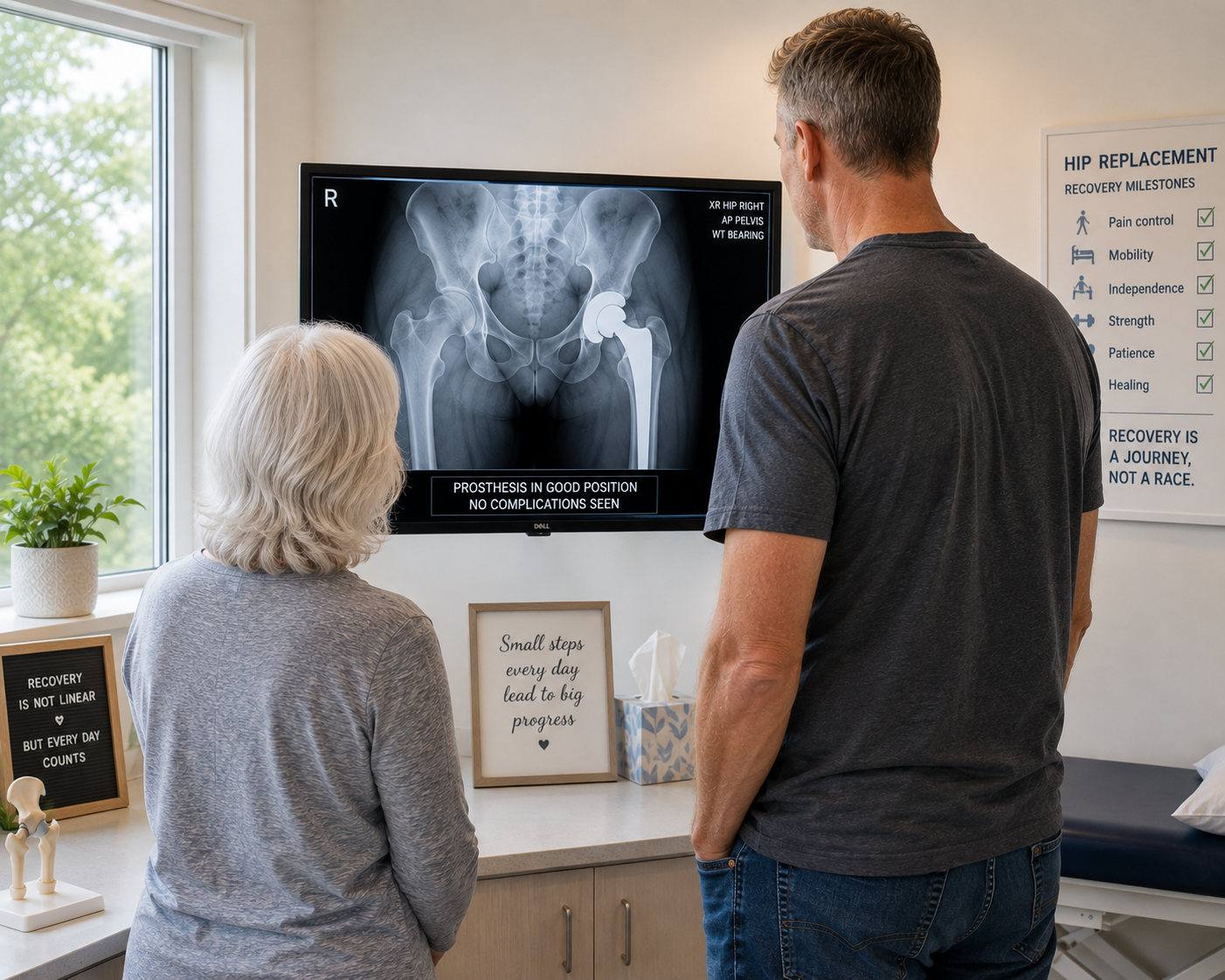
Then, on July 30, I had my first follow-up visit with the surgeon for an X-ray and wound check.
The appointment was held through the fracture clinic, which was convenient because everything could be done in one place.
When it was time for the X-ray, I ran into another problem created by the femoral nerve palsy.
For one of the views, the technician wanted me to stand on my operative leg and lift the other foot so they could get a proper weight-bearing image of the new hip. Under normal circumstances that might not have seemed like a particularly big request.
For me, it was frightening.
My knee had already buckled more than once, and I still didn’t trust that leg to hold me. I asked the technician whether Glen could put on a lead vest and stand behind me so that he could steady me if the leg started to give way.
I think the fact that I specifically asked whether he could wear lead probably gave her some indication that I knew a little bit about what was involved. She was perfectly happy to have him help, especially if it reduced the risk of me falling.
For the first few X-ray views, Glen stood behind the control area with the technician and was able to watch the images appear on the computer screen almost immediately after they were taken.
That was something completely new to him.
When it came time for the weight-bearing view, though, he had to come into the room and stand behind me, so he missed seeing that image appear.
Afterward, he told me he had no idea that modern X-rays showed up on the computer screen almost instantly.
So an appointment that had started with me worrying about whether my leg would hold me also gave Glen an unexpected little behind-the-scenes look at how the X-ray department works.
After the X-rays were finished, I was taken into an exam room for the doctor’s portion of the appointment.
That was when I got the reassuring news.
The bone was healing, and the implant was in good position. After everything that had happened, it was reassuring to know that the actual hip replacement was progressing the way it should.
They did note that I still had a lag in knee extension, another sign that the femoral nerve palsy was continuing to affect the strength and control of that leg.
The dressing was also completely removed at that appointment. The upper part of it had already come off a few days earlier at home, but this was the first time the whole incision was left uncovered.
There were still a few areas along the incision that looked a little moist, which may have been why I was told not to shower without covering it just yet. The doctor told me to wait another two days before showering without covering the incision.
Then, finally, I could shower without plastic and tape protecting the incision.
That may sound like a very small milestone, but by then I had learned that recovery is measured in small things.
A shower without plastic and tape. An X-ray showing the implant where it should be. A wound that was healing. One less piece of medical equipment to work around.
I was told to come back again in four weeks for another follow-up.
It was a bit of a mixed report: the new hip was doing exactly what it was supposed to do, while the nerve controlling part of the leg was still taking its own much slower path toward recovery.
But the hip was healing.
And at that stage, I was learning to take progress wherever I could find it.
Medical Disclaimer
This post reflects my personal experience with hip replacement surgery and recovery. It is not intended as medical advice, diagnosis or treatment. Everyone’s recovery is different. If you have questions or concerns about your own symptoms, medications or recovery, please speak with your healthcare provider.