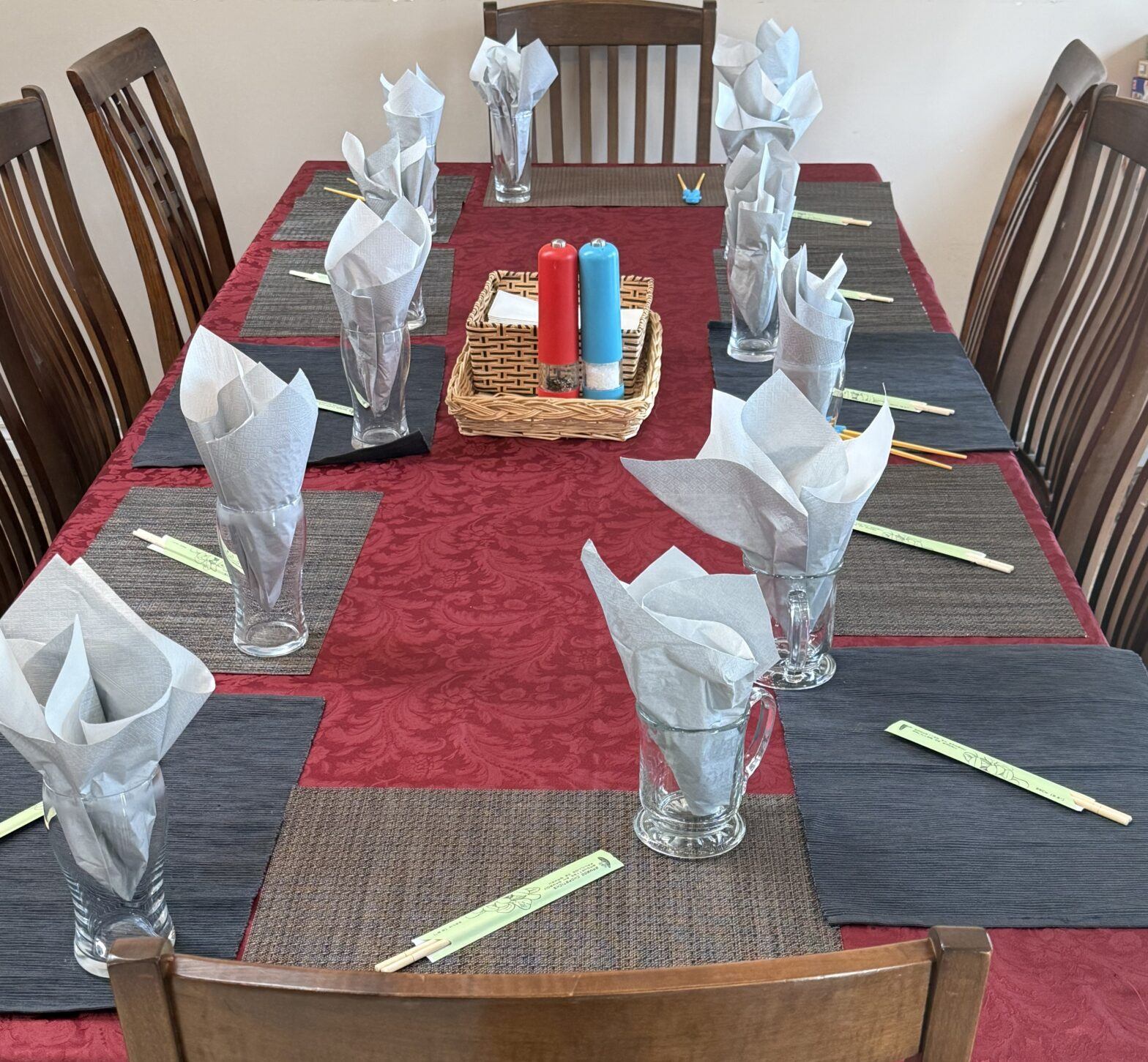
For my birthday this year, I asked everyone to put down their forks.
My birthday falls on Saturday, and under normal circumstances we would have gathered for our usual Sunday family birthday dinner. This year, however, my hip replacement surgery is scheduled for Monday. Rather than enjoy a big family meal the day before surgery, I suggested we celebrate on Friday instead. I wanted to eat more lightly over the weekend and not go into surgery feeling weighed down from a large meal.
The choice of Chinese food was not entirely random.
Several months ago, I had bought a whole supply of chopsticks with the idea that someday we would have a family Chinese food dinner and everyone would have to give them a try. I even found beginner chopsticks for the younger children—the kind that are joined at the top to make learning a little easier.
With surgery approaching, it seemed like the perfect opportunity to finally make it happen.
Chinese food can also be fairly salty, and I know myself well enough to expect a little fluid retention and perhaps a slight rise in blood pressure afterward. By having the meal on Friday instead of Sunday, I was hoping everything would settle back down before Monday morning.
So, Chinese food it was—with chopsticks.
The challenge, of course, was learning how to use them.
Some members of the family were already quite capable. Others had a little more of a learning curve ahead of them. I expected there would be more than a few grains of rice that never reached their intended destination. Chinese food offers all kinds of opportunities for chopstick failure. Some foods are slippery. Some are awkward to pinch. Some require exactly the right amount of pressure because, if squeezed too firmly, they have a tendency to shoot across the plate instead of politely travelling toward your mouth.
I was expecting quite a mess.
I was also expecting quite a lot of laughter.
As if watching everyone’s chopstick attempts wouldn’t provide enough entertainment, I decided we also needed a little dinner conversation. So I began creating a trivia game.
That probably says something about me.
I’ve always believed that learning shouldn’t stop when we leave school, retire from work, or reach a certain age. There is always something new to discover, and I still enjoy finding ways to share those discoveries with my family. If everyone leaves the table knowing one thing they didn’t know when they sat down, I consider that time well spent.
The plan was simple enough: a handful of true-or-false questions, a few multiple-choice questions, and perhaps a “Guess the Country” challenge—all centred around eating utensils.
I expected to learn a little about chopsticks.
Instead, one question led to another, which led to another, and before long I had disappeared down a fascinating rabbit hole.
I learned that chopsticks were probably first used for cooking rather than eating. They allowed food to be safely retrieved from hot cooking pots. As foods gradually began to be cut into smaller, bite-sized pieces before cooking and serving, chopsticks naturally became practical eating utensils. They have now been part of everyday life in many Asian cultures for thousands of years.
The progression seemed wonderfully logical. What began as a simple cooking tool gradually evolved into an eating utensil—a reminder that some of our most familiar everyday objects often begin as practical solutions to ordinary problems.
Then I discovered that the spoon is actually the oldest member of our cutlery drawer. Long before there were blacksmiths, pottery, or even written language, people were using shells, hollowed gourds, carved pieces of wood, and other naturally shaped objects to scoop liquids and soft foods.
The knife has an equally ancient history. Before it became one piece of a matching cutlery set, it was simply one of humanity’s essential tools—used for hunting, preparing food, cutting it, and eating it. For centuries, people commonly carried their own knife with them wherever they travelled.
Then came the biggest surprise of all.
The fork.
Like many people, I had simply assumed it had always been sitting beside the plate.
It hadn’t.
Although larger forks had been used for cooking and serving food for centuries, the personal dinner fork was slow to find its place at the table. It first became fashionable among wealthy Italian families before gradually spreading throughout Italy and then into the royal courts of Europe.
Not everyone welcomed it.
Many people thought the fork was unnecessary, pretentious, or even rather ridiculous. Why use a special metal utensil when fingers, bread, knives, and spoons had worked perfectly well for generations?
One of the best-known early appearances of the personal dinner fork in Venice occurred around 1004, when Maria Argyropoulina, a noblewoman from the Byzantine Empire—the wealthy Eastern Roman Empire centred on Constantinople (modern-day Istanbul, Turkey)—married Giovanni Orseolo, the son of the Doge of Venice. She brought the refined customs of the Byzantine court with her, including the use of a small golden fork at the table. Rather than inspiring immediate admiration, the practice was criticized by some as extravagant and vain.
The fork did not become common overnight, but its use gradually spread among wealthy Italian families. By the Renaissance, it had become increasingly associated with refinement and fashionable dining, and from Italy it slowly travelled into other European courts and households. Even so, it was not until the 1700s that the dinner fork became common across much of Europe and Britain.
Perhaps I found that especially interesting because Glen and I travelled through Italy just over a year ago. We wandered the streets of Venice, explored Florence, admired the magnificent Renaissance art and sculpture, and immersed ourselves in the history of that remarkable period. At the time, I had no idea that Venice had also played a part in the much quieter history of something we now take entirely for granted—the fork beside our plate.
Then there was bread.
Long before forks became common, bread often served as an eating utensil. Pieces of bread or flatbread were used to scoop stews, pick up meat and vegetables, and soak up the last delicious drops of gravy or sauce.
The interesting thing is that this tradition hasn’t disappeared.
Give us a bowl of soup with fresh bread, a hearty stew, or a turkey dinner with warm buns and gravy, and many of us still use the bread to mop up every last tasty bit from the plate. We may not think of bread as a utensil anymore, but sometimes it still performs that role beautifully.
Then I found myself reading about napkins.
People have been trying to keep themselves reasonably clean at the dinner table for centuries. Sometimes that meant cloth napkins. Sometimes it meant bread or dough. Sometimes, apparently, it meant clothing—or even the tablecloth.
That part made me laugh.
Any parent or grandparent knows that children have a remarkable talent for making a mess while they eat. My own grandchildren are no exception. They happily eat with their fingers, wipe sticky hands on their sleeves, lift the front of their shirts to clean enthusiastic faces, and occasionally decide that Nana’s tablecloth works perfectly well too.
In that respect, they’re simply following in their parents’ footsteps.
Perhaps they’re reminding us that, despite thousands of years of history, some things around the family table never really change.
By the time I finished writing the trivia game, I had learned far more than I ever expected.
My hope was that everyone around our family table would leave that evening having learned something new as well.
So, how did our Chopstick Challenge turn out?
Better than I had imagined.
Everyone joined in wholeheartedly. The younger children used their beginner chopsticks, while the adults gave the traditional ones an honest try. Some family members looked surprisingly comfortable with them, while others needed a little more practice.
There was, however, one universal discovery.
Chicken balls are much easier to spear than they are to pinch.
There was the occasional strategic stab, a few moments when fingers quietly came to the rescue, and plenty of laughter as everyone figured out the best technique. To my surprise, there wasn’t nearly as much flying food as I had predicted.
The trivia game was every bit as enjoyable as the chopsticks.
We talked about the history of spoons, knives, forks, chopsticks, bread, napkins, and the many different ways people around the world have shared meals throughout history. Some answers surprised everyone. Others sparked conversation. Best of all, I think every person at the table learned at least one thing they hadn’t known before.
That made me smile.
Perhaps the retired nurse and lifelong learner in me never really disappears. I still enjoy discovering something new and then passing it along. Learning doesn’t have to happen in a classroom. Sometimes it happens around a dinner table while sharing a meal with people you love.
The more I reflected on the evening, the more I realized that our little experiment had become about much more than chopsticks.
For thousands of years, meals like this have been enjoyed with chopsticks. We were the newcomers. Like many North Americans, we’re accustomed to automatically reaching for a knife and fork. For one evening, we stepped outside our usual habits and experienced the meal a little closer to the way it has traditionally been enjoyed for generations.
The trivia reminded us that there has never been just one “right” way to eat.
Different cultures developed different utensils—or sometimes no utensils at all. They used what made sense for the foods they prepared, and each tradition evolved for practical reasons. There is something rather wonderful about that.
Of course, no account of the evening would be complete without mentioning Piper.
She faithfully carried out her self-appointed duties beneath the table from beginning to end.
At first, we became convinced that we could identify the messiest eater simply by watching where Piper chose to sit. If she suddenly moved to your side of the table, everyone immediately assumed you were dropping the most food.
Or were you?
It wasn’t long before someone protested, “It’s not me—it’s the person beside me!”
Apparently Piper wasn’t always the most reliable witness.
At one point she abandoned everyone else altogether and stretched herself comfortably across my feet. I’d like to believe that’s simply one of her favourite places to relax while we’re eating and not because I was being especially generous with falling food.
At least, that’s my story, and I’m sticking to it.
As I looked around the table that evening, I realized how fortunate I am.
Glen had once again taken care of dinner. In our house, when Glen says he’s cooking, it often means he has arranged the takeout—and this Chinese feast was an excellent example. Family members had helped set the table, brought appetizers, cleared the dishes, washed up, and simply pitched in wherever they were needed. Nobody complained about using chopsticks. Nobody rolled their eyes at the trivia questions. Everyone embraced the idea with good humour.
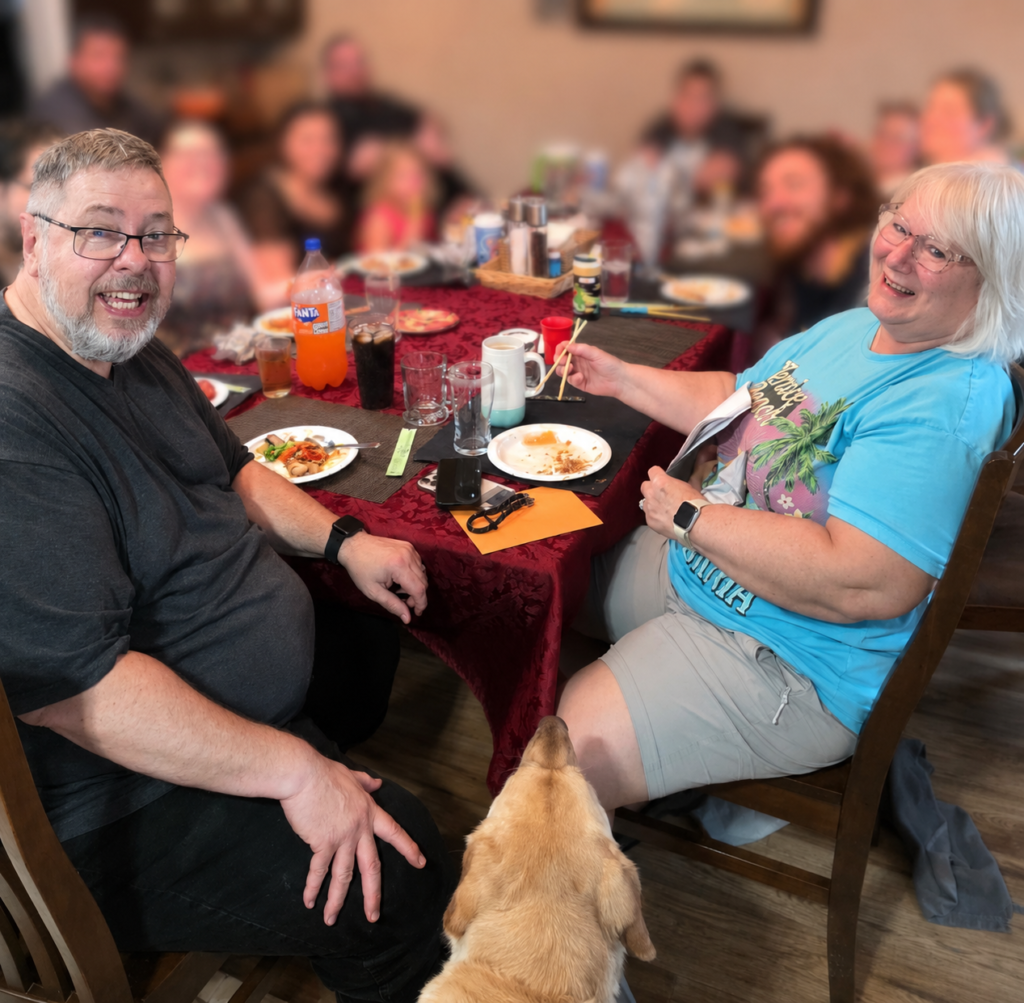
What began as a birthday dinner became something much more meaningful.
It became an evening of curiosity.
An evening of learning.
An evening of laughter.
An evening of cooperation.
Most importantly, it became another family memory.
As I prepare for hip replacement surgery on Monday, I can’t think of a better way to begin this next chapter. Instead of spending the weekend worrying about surgery, I was reminded of something much more important.
Life isn’t measured only by the big milestones.
Sometimes it’s measured by the simple evenings when a family gathers around the table, tries something new together, learns a little history, laughs at themselves, and leaves with full stomachs, warm hearts, and perhaps just a little more knowledge than they brought with them.