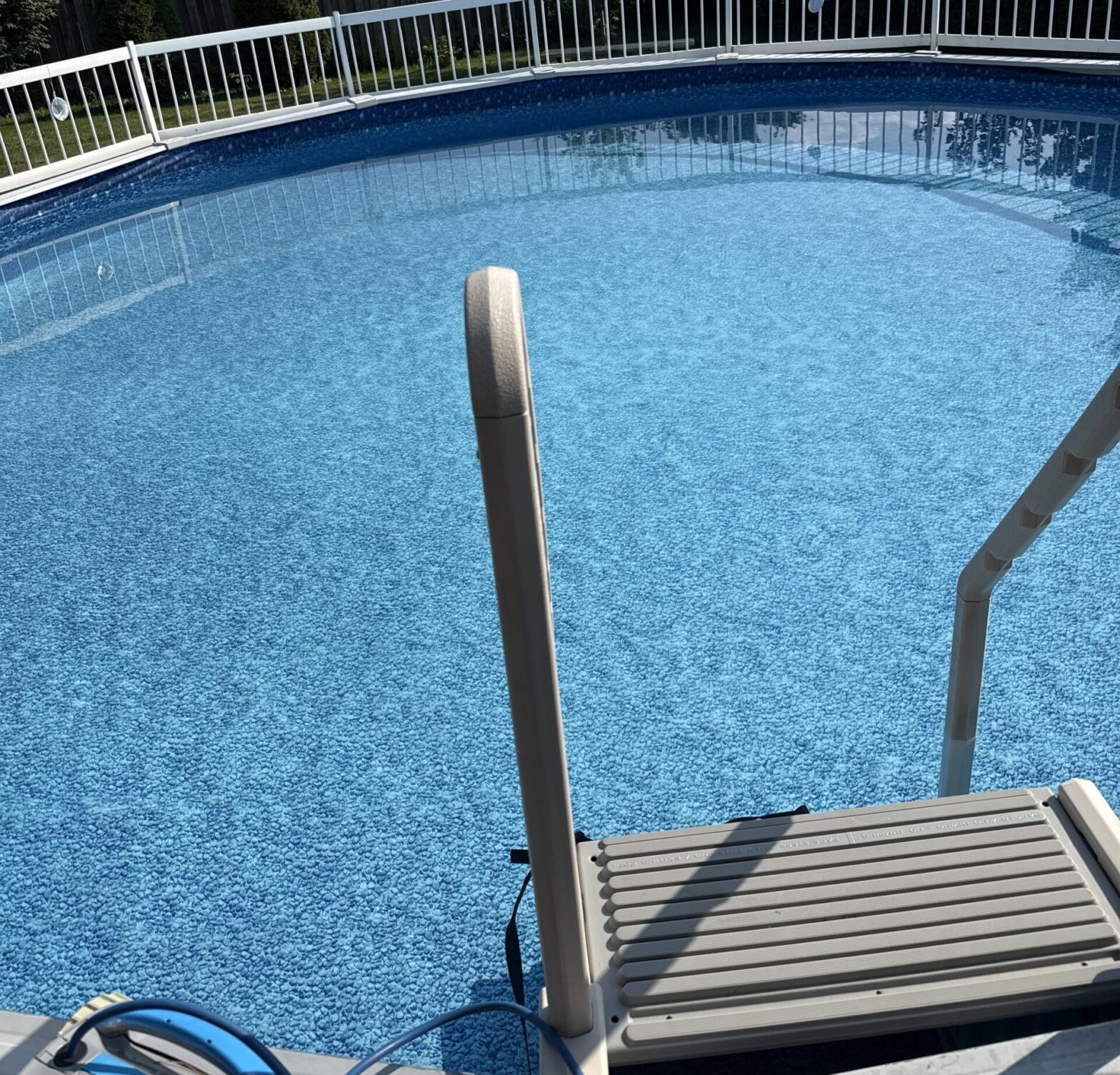
There is definitely an art to keeping pool water clear.
Yes, there is science involved. There are test strips, water samples, chlorine levels, pH readings, alkalinity, stabilizer, and all the other numbers that come with trying to keep a pool balanced.
But there is also the art of paying attention.
That was the case with my above-ground pool this week.
We have been in a stretch of very hot July weather. Along with the heat, we also had rain and some high winds that blew debris into the pool. The water still looked good, but I know from experience that hot weather, rain, wind, debris, and circulation demands can all add up quickly.
So I kept an eye on things.
I used the pool robot to help keep the bottom clean. I kept the skimmer cleaned out so the water could keep moving properly. I watched the filter pressure and backwashed when needed.
I should also say that I am not doing all of this alone right now.
With my hip replacement surgery getting closer, my mobility is limited, and going down the deck steps to ground level where the pool pump and filter are located is not always easy. Some days I can manage it. Some days I look at those steps and know I should not push my luck.
So pool care has become a bit of a team effort.
My son helps me. When I run the pool crawler, he takes it out of the pool for me when it is done. He keeps an eye on the skimmer and the chlorine pucks, and I do too when I can manage the deck steps without too much pain. Sometimes I peer over the railing to check the skimmer basket from above. If I can get down there safely, I clean it myself. If I cannot, I ask him to do it when he comes by after work.
He also looks after adding chemicals from the larger containers for the most part, but he does it with my direction.
In other words, he is learning my system.
And that matters too.
Pool care is not only about the person who physically lifts the container, empties the skimmer, checks the pump area, or pulls the crawler out of the water. It is also about noticing what needs to be done, understanding why it matters, and keeping the routine going even when life requires a few adjustments.
On Thursday, I tested the water with a test strip.
The pH looked a little low.
The pool itself looked fine. The water was clear. There were no obvious problems. No cloudiness. No strange colour. No urgent backyard pool drama.
But I decided to make a small correction before a small imbalance turned into a bigger problem.
I added pH Up, following the directions on the product for the size of my pool. I also went a little on the light side because I have learned one very useful pool lesson:
It is usually easier to add a little more than it is to undo adding too much.
After that, I ran the pump for several hours. I let the pool circulate overnight, ran the pump again the next morning, and then took a proper water sample to the pool store.
I like to follow up with a pool-store sample when I am making adjustments because test strips are useful, but they can be hard to read exactly. They can tell you the general direction you are headed, but sometimes it is difficult to know precisely where your water really stands.
The pool-store test gave me the answer I was hoping for.
Clear water. Balanced pH. Good chlorine. No combined chlorine.
That may not sound very exciting unless you own a pool. But if you do, you know exactly how satisfying that feels.
The report showed a pH of 7.6, free chlorine and total chlorine both at 3.44 ppm, and combined chlorine at 0. That last number always makes me happy because it means the chlorine is not tied up fighting a hidden problem.
The alkalinity was 107 ppm, hardness was 190 ppm, and the phosphate reading was low at 28 ppb. For early July, after heat, rain, wind, and debris, I was more than pleased with those numbers.
While I was at the pool store, I asked whether people were having pool problems yet during this heat. The answer was yes — mostly cloudy pools. And cloudy pool water is often connected to water balance, circulation, filtration, and all the little things that may have been missed before the cloudiness appeared.
That made me feel even better about catching the issue early.
This is the part of pool care that does not always get enough attention. We tend to talk about fixing problems once they appear: cloudy water, green water, low chlorine, algae, clogged filters, mystery readings, and all the frustration that comes with them.
But a lot of good pool care is quiet prevention.
It is testing when the water still looks fine.
It is cleaning the skimmer before circulation becomes a problem.
It is running the robot after wind and rain bring debris into the pool.
It is getting leaves, dirt, bugs, and other material out before the chlorine has to work harder than it should.
It is watching the filter pressure and backwashing when the pressure rises.
It is circulating the water long enough after adding a product.
It is following directions, but not overreacting.
It is using test strips as a guide, then confirming with a proper water sample when you need a more exact reading.
None of those things is dramatic.
But together, they matter.
That is true in pool care, but it is also true in publishing, business, and many aspects of life.
Books are not usually built by one big burst of inspiration. They are built by showing up, revising, formatting, checking details, fixing small errors, learning the next step, and doing the quiet work that supports the final product.
A small business is much the same.
So is home maintenance.
So are health habits.
So are relationships, finances, gardens, and most long-term goals.
The little actions are easy to underestimate because they do not always look important in the moment.
They may not seem urgent while everything is going well, but they are often what keeps everything from turning cloudy.
I am not a pool store. I am not a chemist. I am a pool owner who has learned, sometimes the hard way, that simple routines matter.
And this little July success reminded me why I wrote The Practical Guide to Above-Ground Pool Care: What to Do—and Why to Do It.
Pool care does not have to be mysterious. It does not have to be overwhelming. But it does help to understand what you are doing and why you are doing it.
Because whether we are caring for a pool, building a book, running a small business, or simply trying to manage everyday life, understanding the “why” behind the routine can make the whole process feel less overwhelming.
Sometimes success is not about making one heroic move.
Sometimes it is about noticing early, acting calmly, and keeping up with the small things before they become big things.