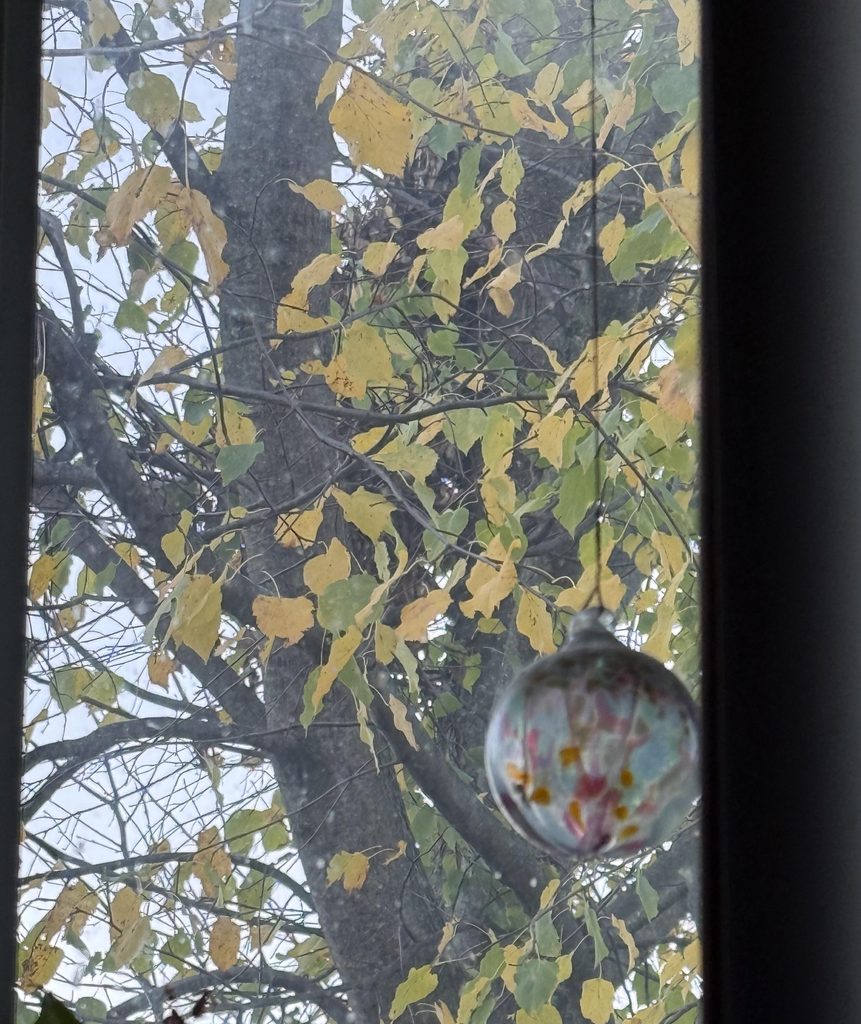
When you spend part of your retirement sitting at a computer desk in front of a large window, you get to know the view outside pretty well.
All summer long, my view is a thick wall of green leaves courtesy of the towering linden tree in our yard. Looking at how it rises above the house today, it is hard to believe that it started out about 25 years ago as a tiny tree in a flower pot. The kids had gone to the mall late one summer—likely during an environmental giveaway event—and came home with a free seedling. We were just about to leave on vacation, I had no plans for adding another tree to the yard, and I honestly didn’t expect it to survive. I simply looked around the yard, decided, “Well, let’s just put it over there,” planted it, and hoped for the best.
Not only did it survive, it thrived. And now that November has stripped away its summer leaves, that unplanned little tree has revealed a new secret: a large squirrel nest tucked high into its branches.
Taking a Closer Look from the Yard
Over the weekend, I headed outside to do some fall yard work with my family. Even with a bum leg, I try to get out and stay active in the yard—moving very cautiously with my cane, since uneven ground and a wobbly leg don’t exactly get along. Between putting tools and yard gear back into the shed, I made plenty of trips back and forth across the grass, which turned out to be great exercise.
While I was out there, I took a few minutes to photograph the nest up close. Looking at it through the camera, I was surprised by how loose it appeared. Rather than looking like a solid fortress, it looked like a simple clump of leaves—and from one angle, I could almost see right through it.
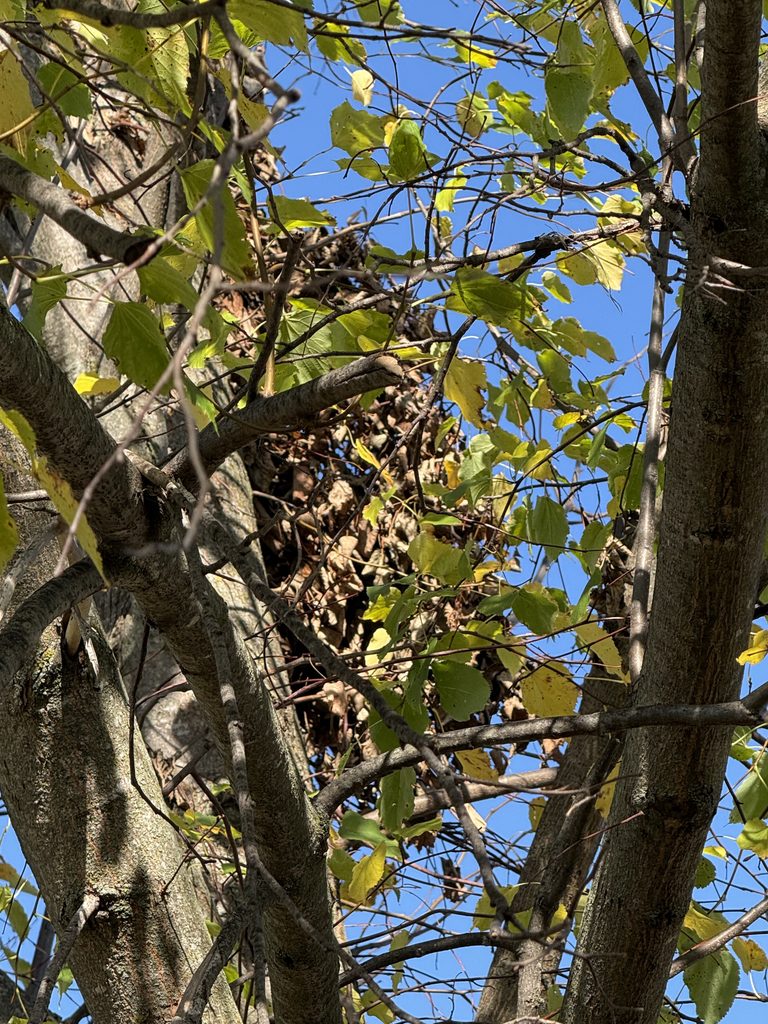
That made me wonder: is this a brand-new nest still under construction, an old one that has been abandoned, or simply how squirrels build them? As it turns out, squirrels actually construct two different types of nests—called dreys—depending on the season:
- Summer Dreys: During warmer weather, squirrels throw together looser, airier platforms of twigs and green leaves that let the breeze flow through so they don’t overheat. Once November winds strip the trees, those summer cottages often look ragged and see-through.
- Winter Dreys: For cold Canadian winters, squirrels build much denser retreats, typically wedged tightly into a main fork close to the trunk, 20 to 30 feet off the ground to protect against winter winds and ground predators. Unlike bears or chipmunks, tree squirrels don’t hibernate—they stay active all winter, simply sleeping in during brutal cold snaps and curling their bushy tails around themselves like built-in blankets. To build a winter drey, they weave an outer frame of twigs and pack it tightly with damp leaves, moss, pine needles, and grass, which dry and compress into a windproof, waterproof shell. Inside, they line the chamber with soft materials like shredded bark, dry grass, fur, or feathers. Amazingly, a well-built winter drey can stay 20°F to 30°F (11°C to 16°C) warmer inside than the freezing air outside.
I happen to know firsthand just how creative they can be when hunting for insulation. A few years ago, I caught a squirrel on our front porch digging into one of our patio cushions and making repeated trips through the side yard and over the wooden fence into the neighbour’s yard with its cheeks stuffed full of batting. A neighbour later confirmed that squirrels were building a nest a few houses away. Fortunately, my cushions have been spared this autumn, though it looks like the local wildlife has decided to move much closer to home.
The Neighbourhood Real Estate Rules
Seeing that loose nest also made me wonder what happens if a squirrel moves on—or if something happens to it after it builds a cozy home. In the tree canopy, good real estate rarely stays empty for long.
Squirrels mark the entrance of their dreys using scent glands on their cheeks, paws, and mouths. As long as the resident is coming and going, that scent acts like an “Occupied” sign. If something happens to the builder, that fresh scent fades within a few days. Neighbouring squirrels keep a close eye on the trees, and once they notice the coast is clear, another squirrel will happily move in, inspect the twig frame, and pack fresh leaves and grass into the gaps to renovate it for winter.
Because squirrels maintain two or three backup dreys across their territory, squatter standoffs do occasionally happen. If a storm damages a squirrel’s main home and it rushes to a backup nest only to find a neighbour curled up inside, it usually sparks a loud round of barking, chattering, and tail-flicking until the rightful owner reclaims its space.
Scatter-Hoarding and the Black Walnut Route
Setting up home in our linden tree certainly comes with great location perks. Just a block away, in a quiet, park-like community green space with a little stream running through it, stands an old black walnut tree. Those rugged, thick-shelled nuts are packed with fats and calories—essential fuel for surviving an Ontario winter.
All autumn long, the squirrels run a steady commute from that open space across the neighbourhood to stock their pantry. Instead of keeping one big stash, squirrels practice scatter-hoarding—burying nuts individually in hundreds of separate spots throughout our yard, the neighbours’ yards, and the surrounding green spaces. They are also famously paranoid about theft: if a squirrel suspects another squirrel (or a human watching from a window) is looking, it will dig a hole, pretend to drop the walnut in, pat the dirt down, and sprint off with the nut still tucked in its mouth to hide it somewhere else.
Come winter, they rely on a keen sense of smell and sharp spatial memory to dig those black walnuts up right through the snow—though they inevitably forget a few, making them accidental gardeners whenever a tiny walnut sapling sprouts up in a spring flower bed. I regularly find cracked black walnut shells scattered across our lawn, and even up on the deck, which seems to serve as a safe, elevated dining spot where they can keep watch for hawks and neighbourhood cats.
Walnuts aren’t the only item on the local menu, either. This past summer, my son—who lives at home with us—decided to grow tomatoes. He built a raised garden bed using wooden skids from his work and planted his crop using big pails from Firehouse Subs. Everything was thriving, with tons of tomatoes ripening on the vines—until they started mysteriously disappearing. Sure enough, my son spotted bright red tomatoes sitting right up in the tree branches, and he was completely convinced the squirrels were the culprits. (As it turns out, he was almost certainly right: in the heat of summer, squirrels frequently steal ripe tomatoes not for food, but for the water inside them—often taking a couple of juicy bites and leaving the rest behind on a branch or fence post!)
Fence Highways and Piper’s Daily Standoffs
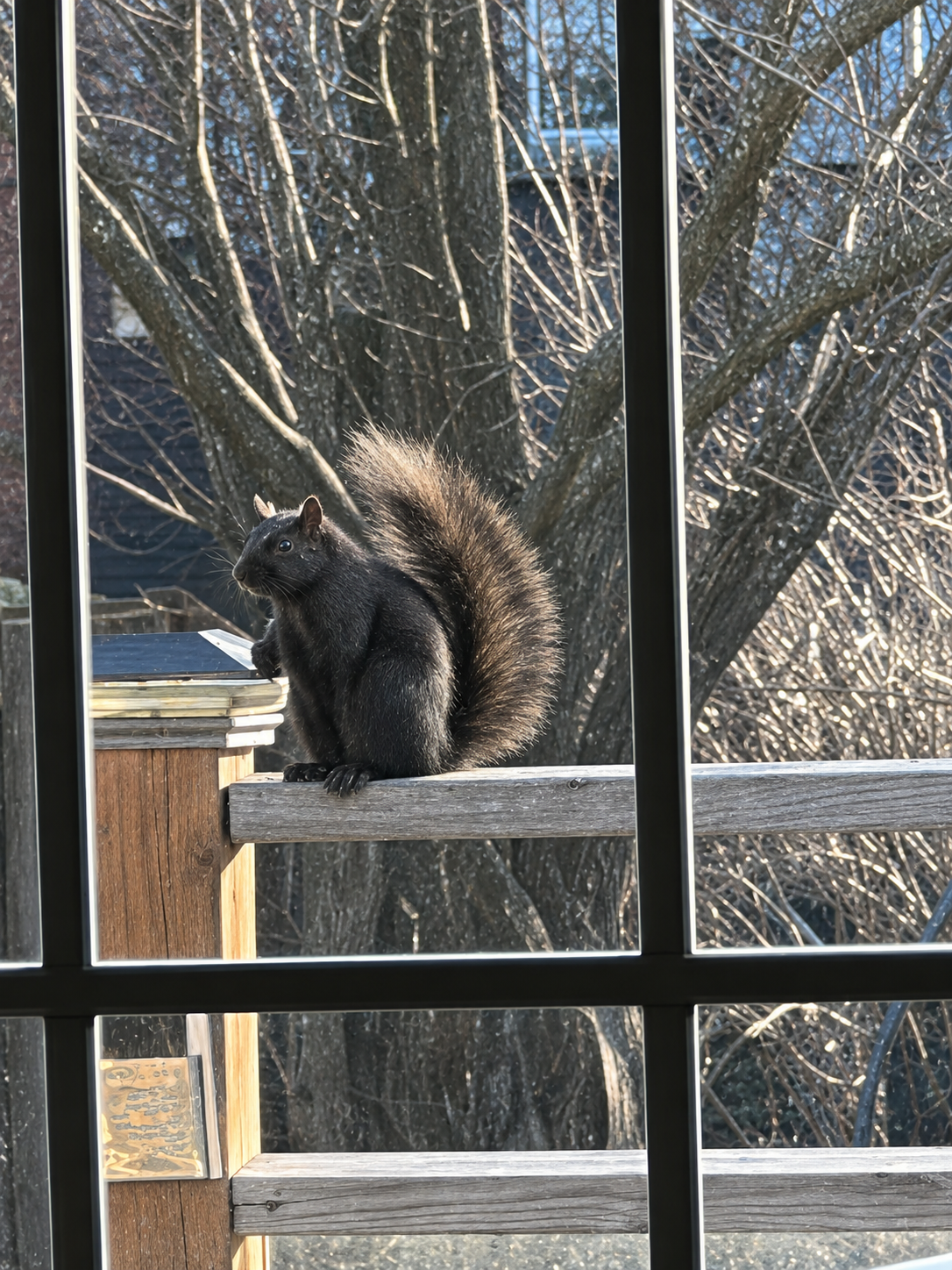
One of the squirrels I have been seeing around the linden tree this year is a black squirrel—which, as many Ontarians know, isn’t a separate species at all. It is simply an eastern grey squirrel with a natural genetic variation that gives it dark fur, along with a handy bonus: dark fur absorbs more sunlight, helping them stay a little warmer on sunny winter days.
The squirrels love to use the wooden fence surrounding our backyard as their personal highway, which gives our dog Piper plenty of daily entertainment. Piper loves to bark at them whenever they travel along the fence line, though the squirrels seem completely unbothered. Often, I will look out to see a squirrel sitting calmly on top of the shed or perched on the fence while Piper barks like crazy below—and the squirrel just sits there staring down at her as if to say, “What?”
Seeing this black squirrel around the yard also has me wondering if we have a family connection here. About three years ago, when Piper was just a puppy, a particularly mischievous black squirrel used to visit our yard and keep us endlessly entertained. Eventually, it disappeared. Since wild squirrels typically live four to six years—and black and grey babies can even be born in the very same litter—I like to think this year’s resident is either that original squirrel returning to familiar territory, or one of its offspring taking over the family walnut route.
Winter Roommates and Male Bachelor Pads
As temperatures plunge, squirrel living arrangements shift depending on the season and whether the resident is male or female. Although squirrels live alone for most of the year, they frequently share a winter drey—packing two to five squirrels inside a chamber roughly six to eight inches wide to conserve body heat.
Most often, those winter roommates are a mother alongside her grown babies from late summer. Squirrels carry a unique “family scent” from months of sharing a nest and grooming one another. Because young females tend to settle in trees right next door to their mothers, a mother and her daughters can recognize each other by scent for years, sometimes even curling up together with newer siblings during bitter cold snaps. Adult males, on the other hand, generally live a more nomadic life, sleeping alone in single “bachelor” dreys scattered across a wider territory—though during brutal January freezes, even bachelor males will occasionally join a winter huddle for warmth.
Twice-a-Year Mating Seasons and Fierce Single Moms
That winter truce ends abruptly when mating season kicks off. In Ontario, squirrels actually have two mating seasons a year: the first runs from late January into February, and the second takes place in May and June.
After a pregnancy of about six and a half weeks (around 44 days), a female gives birth to a spring litter in late February to April, followed by a second litter in July or August. Each litter typically has two to four babies (occasionally up to six), which are born blind, hairless, and weighing only about half an ounce.
When it comes to parenting, male squirrels do not participate at all—which suits the mother just fine, because adult males actually pose a serious danger to helpless newborns. As soon as a female gives birth, she becomes fiercely territorial and chases every other squirrel, especially males, away from her nursery tree. If a male or a predator ever gets too close to her nest, she will immediately relocate the entire litter, carrying each baby one by one by the scruff of its neck to one of her spare backup dreys.
Raising a litter single-handedly takes a lot of energy, so a mother squirrel has a clever routine for stepping out to eat. Before leaving the nest, she carefully tucks her hairless newborns beneath the soft inner lining like a warm blanket to trap their body heat while she slips away for a quick 30- to 60-minute meal. The babies stay tucked safely inside nursing for six to seven weeks before poking their heads out to explore the branches, and they are weaned around eight to ten weeks old. While spring babies strike out on their own by summer, the late-summer litter often stays with Mom right into winter.
A Built-In Late-Winter Pantry
While she is nursing, a mother squirrel relies heavily on the black walnuts she buried back in the fall. If deep snow or ice locks away her ground stash in February or March, she doesn’t have to travel far for a backup meal. By late winter, trees like maples, oaks, and my linden tree begin swelling with protein-rich buds she can safely snack on, along with tender inner bark, sweet sap, seeds from nearby evergreens, or even an old shed bone or antler for extra calcium. Happily, a mature 25-year-old tree like ours barely notices a squirrel nibbling on a few upper buds—it acts like a light natural pruning, and the tree bursts right back into full green leaf come spring.
Whether that nest high in my linden tree turns out to be a breezy summer cottage, an active winter renovation, or a cozy family huddle, I am glad we have it. Between Piper’s backyard patrols and the view from my desk, that unplanned mall giveaway from 25 years ago is giving us plenty to watch all winter long.